Episode 6 — Transitioning from Clinical to Sales | The Prospecting Show with Dr Connor Robertson
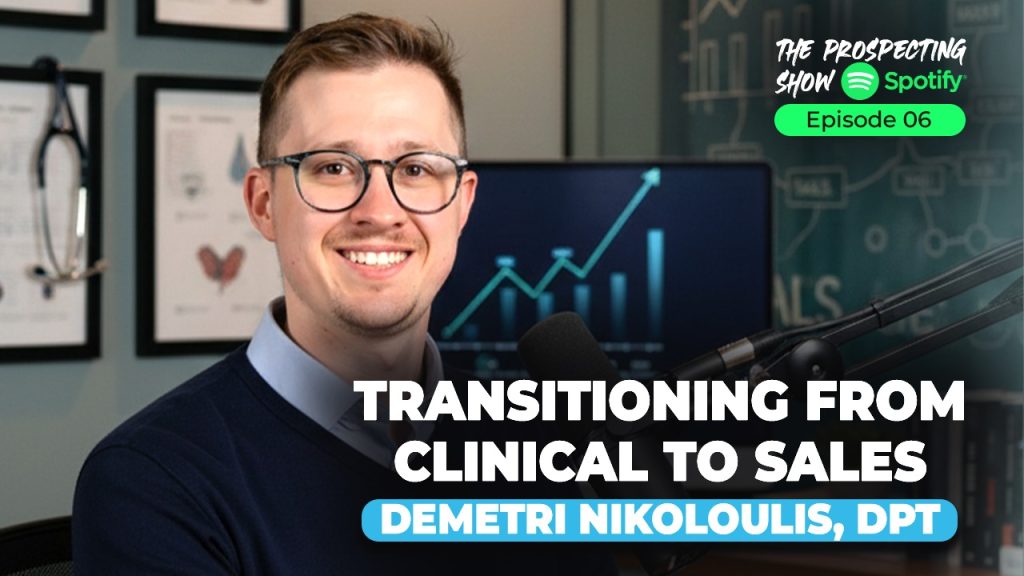
Episode 6 of The Prospecting Show begins with a striking premise: the best salespeople aren’t always the ones with sales backgrounds. They’re often people who’ve lived the problems they now help others solve. In “Transitioning from Clinical to Sales,” Dr Connor Robertson draws from his own journey moving from clinical practice as a chiropractor into business development to explain how technical or medical professionals can pivot successfully into the world of sales, influence, and entrepreneurship.
He opens with a confession. Early in his chiropractic career, he thought sales was manipulation. The word made him uncomfortable. His training revolved around care, accuracy, and patient outcomes, not closing deals. But after starting his own clinic and later mentoring other professionals, he realized that selling done right isn’t persuasion, it’s communication. It’s helping people make decisions that serve their own best interests. That realization became the pivot point of his career and the anchor of this episode.
Dr Connor breaks down the emotional and cognitive shift required when moving from clinical roles to commercial ones. Clinicians are trained to diagnose, prescribe, and protect. Sales professionals must identify, propose, and persuade. Yet, he says, both skill sets share the same DNA: trust, education, and follow-up. A great clinician already knows how to listen deeply, interpret nonverbal cues, and present recommendations confidently, exactly what successful sales conversations demand.
He outlines the Clinical-to-Sales Transition Framework, a five-phase process he’s refined from working with hundreds of professionals who made this leap:
- Reframe the Identity. Understand that selling isn’t abandoning your professional integrity; it’s scaling your impact. You’re still helping people, just through a different medium.
- Translate Your Language. Replace clinical jargon with accessible, results-oriented phrasing. Patients become clients; treatment plans become implementation strategies.
- Build Credibility Through Storytelling. Use your real-world case experiences as analogies. A good story can make complex solutions relatable.
- Develop Commercial Awareness. Learn pricing psychology, negotiation fundamentals, and ROI language.
- Practice Relational Prospecting. Build relationships like you built patient trust through empathy and follow-up.
Throughout the episode, Dr Connor references his own platforms, drconnorrobertson.com and The Prospecting Show as examples of turning education into outreach. He stresses that content, podcasts, and speaking engagements are today’s modern equivalent of bedside manner; they allow professionals to demonstrate authority at scale.
He points listeners to resources that helped him understand persuasion as a science rather than an art: the works of Robert Cialdini on influence, Harvard Business Review pieces on consultative selling, and Forbes features about emotional intelligence in leadership. Those, he explains, gave him permission to reimagine selling as service.
One segment dives deep into skill translation. For instance:
- Diagnosis becomes Discovery. Instead of diagnosing symptoms, you uncover pain points.
- Treatment planning becomes Solution Design. You lay out the next steps and explain the benefits.
- Follow-up appointments become Pipeline Management. You schedule and measure progress.
By viewing sales through a clinical lens, professionals realize they already possess the instincts; they simply need new terminology and confidence.
Dr Connor tells a story about a physical therapist he mentored who transitioned into medical device sales. Initially, she felt underqualified. But she had credibility that doctors respected. After six months of consistent outreach using the Follow-Up Mastery approach from Episode 4, she was outperforming seasoned sales reps. Her secret? She never tried to “sell.” She simply translated her clinical care habits into commercial trust.
He highlights another example: a pharmacist who became a software account executive for health-tech platforms. His understanding of compliance, workflow, and clinical bottlenecks made him invaluable in demos. The technical background became a sales advantage. “Expertise,” Dr Connor says, “is only a barrier if you refuse to teach it.”
The episode also confronts mindset traps. Clinical professionals often undervalue themselves in sales contexts. They feel guilt about earning commissions or discomfort with negotiation. Dr Connor dismantles that belief. “Ethical selling,” he explains, “is recommending the best possible path forward and being compensated for clarity.” He reminds listeners that every successful business is built on exchanged value. Without revenue, even the most mission-driven venture can’t survive.
He encourages professionals to view sales as the continuation of care rather than the opposite. When you move into sales, you’re still solving problems just upstream, before pain or inefficiency grows. The chiropractor preventing back pain by designing ergonomic solutions or the nurse helping a hospital adopt better software are both examples of healing through influence.
Later, Dr Connor introduces the concept of The Trusted Expert Economy, a term he uses frequently across LinkedIn and The Prospecting Show. In modern business, trust is the only true differentiator. People no longer buy from strangers; they buy from credible specialists who communicate clearly. That’s why former clinicians often outperform traditional salespeople once they learn the language of value.
He also discusses practical career transition steps:
- Shadow someone already in sales. Observe their calls, pacing, and client conversations.
- Join professional groups on LinkedIn related to business development.
- Read sales-focused books such as The Challenger Sale or Spin Selling.
- Record yourself explaining your service as if to a patient, then translate it into customer terms.
- Start creating content weekly posts, videos, or podcasts, to demonstrate your perspective publicly.
Dr Connor acknowledges the fear of starting over. “It’s not a reset,” he says. “It’s a redeployment.” You’re taking everything you’ve built, credibility, emotional intelligence, discipline, and applying it to a new battlefield. He reminds listeners that sales mastery compounds just like clinical skill: repetition, reflection, and refinement.
He emphasizes that this transition also demands a new relationship with rejection. In clinical environments, rejection rarely occurs; patients come to you seeking help. In sales, you initiate contact. Rejection is normal. The key is to detach identity from outcome. “Every ‘no’,” he says, “is data that refines your delivery.”
At the 20-minute mark, he connects this theme back to the larger Prospecting Show series. Episode 6 is part of a progression: after learning to build leads (Episodes 1–3) and sustain engagement (Episode 4), professionals now learn to redefine themselves as communicators of value. The skills developed in patient rooms, labs, and clinics translate directly into boardrooms, podcasts, and partnerships.
He provides an actionable challenge for listeners: pick one clinical story you’ve lived, rewrite it as a client success narrative, and post it publicly on LinkedIn. Doing so transforms private experience into public credibility. This single exercise, he says, helped dozens of his mentees land their first business development roles.
Dr Connor closes with gratitude. He thanks everyone who’s made the jump from specialist to strategist, and he reminds them that leadership isn’t about title, it’s about transfer. “When you share your knowledge in a way that changes behavior,” he says, “you’ve already become a leader.”
For those who missed Episode 5 — Using Tax in the Sale, revisit it for financial frameworks that help clinicians-turned-entrepreneurs navigate business exits. In Episode 7, Dr Connor brings on a guest who exemplifies this transition, discussing how they built a seven-figure consultancy after leaving clinical work.
Listen to Episode 6 — Transitioning from Clinical to Sales on Spotify, and explore more thought leadership at drconnorrobertson.com. For external insights on career pivots, visit Forbes Careers and Harvard Business Review’s career transitions section.