Episode 19 — Part 1 of 6: Educator Mindset with Dr. Mat DiMond
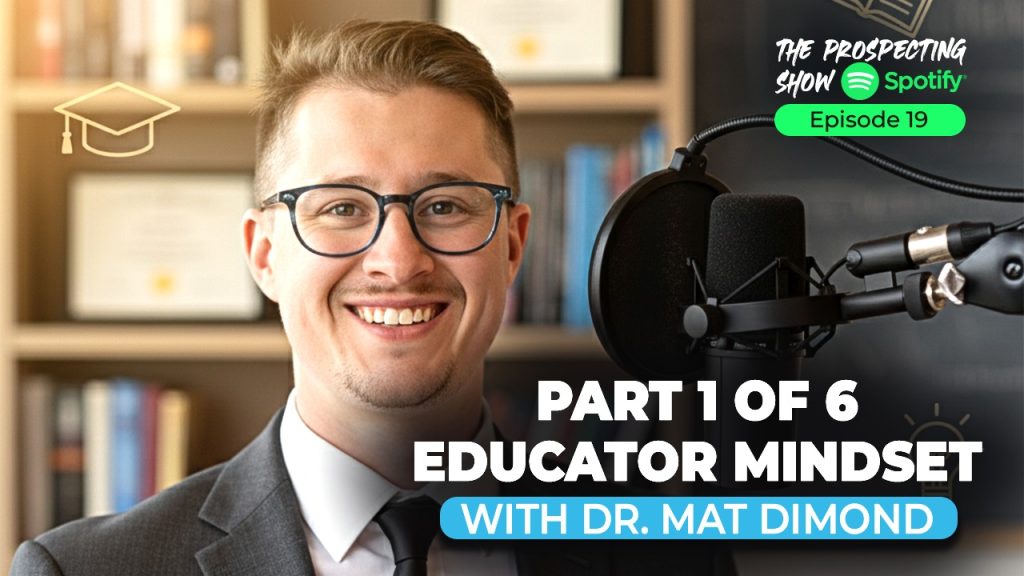
In this powerful episode of The Prospecting Show, Dr Connor Robertson sits down with Dr Mat DiMond to unpack what it means to live with an educator mindset, a philosophy that extends far beyond the classroom into business, leadership, and personal growth.
Following the strategic focus of Where to Use Your Virtual Assistants, this episode pivots toward the human side of scaling: how education, empathy, and curiosity fuel professional excellence.
Redefining the Role of the Educator
Dr DiMond begins with a bold statement: “Education isn’t about information, it’s about transformation.”
He and Dr Robertson discuss how teaching is not limited to professors or classrooms. “Every leader is a teacher,” Dr Robertson says. “Whether you’re managing a team or mentoring a colleague, you’re shaping someone’s mindset.”
Dr DiMond agrees, noting that an educator mindset means seeing every interaction as an opportunity to empower others. “If you can’t transfer knowledge, you’re hoarding potential.”
The Lifelong Learning Philosophy
At the core of the educator mindset is lifelong learning, a commitment to curiosity over certainty.
Dr Robertson reflects, “The most successful professionals I’ve met treat learning as oxygen, not obligation.”
Dr DiMond expands on this idea, emphasizing that curiosity is contagious. “When leaders remain students, their teams follow suit. The best cultures are built around learning.”
This mindset mirrors the growth frameworks from the Credit Foundation discussion, where discipline, not luck, drives success.
The Intersection of Education and Empathy
Both doctors explore how empathy underpins true education. “Students or employees don’t learn from authority, they learn from connection,” Dr DiMond says.
Dr Robertson adds, “Empathy turns instruction into influence. People remember how you make them feel before they remember what you said.”
They emphasize that modern leaders must educate through listening first. “The more you understand people, the better you can guide them,” Dr Robertson notes.
Education in Entrepreneurship
While traditional educators teach concepts, entrepreneurs teach through results. Dr Robertson shares, “Every entrepreneur becomes an educator the moment they start explaining their vision.”
Dr DiMond highlights that business education often lacks emotional intelligence. “We teach the mechanics of scaling but not the mindset of service,” he says.
Dr Robertson agrees: “Real education is measured not in degrees but in the number of people you uplift.”
Turning Expertise into Impact
Dr Robertson asks how professionals can use their expertise to educate others. Dr DiMond responds, “Start by simplifying your message. If you can’t explain it simply, you don’t understand it deeply.”
He continues, “Educators translate complexity into clarity. That’s the true superpower of leadership.”
Dr Robertson adds, “That’s why content creation is so powerful. When you teach what you know, you refine what you believe.”
Their conversation connects to earlier discussions on delegation and scaling education becomes a tool for multiplying your impact.
The Feedback Loop of Learning
Dr DiMond discusses the importance of feedback in growth. “Teachers learn as much from their students as students do from teachers. Feedback fuels evolution.”
Dr Robertson calls this the reciprocal learning loop. “When you stay open to learning from others, you never stagnate. Education becomes a living ecosystem.”
He notes how this same principle applies in business: “The market is your classroom. Your customers are your teachers.”
Overcoming the Fear of Not Knowing
Many professionals resist teaching because they fear imperfection. Dr DiMond encourages them to embrace vulnerability. “The best educators admit they don’t know everything. That humility builds trust.”
Dr Robertson echoes this sentiment: “Perfection blocks progress. Sharing what you’re learning—even in real time is what inspires others.”
He adds, “Knowledge hoarded dies. Knowledge shared scales.”
From Classroom to Culture
Dr DiMond describes how educational principles can transform corporate culture. “A culture of teaching and learning eliminates hierarchy. Everyone becomes both student and mentor.”
Dr Robertson agrees, pointing out how this dynamic strengthens retention and innovation. “When people feel valued for what they teach, they stay invested in the mission.”
This idea ties directly into the operational structure he outlined in Where to Use Your Virtual Assistants where empowerment and clarity replace micromanagement.
The Educator’s Mindset Framework
Dr DiMond outlines a framework for professionals to cultivate the educator mindset:
- Curiosity – Always ask “why” before “how.”
- Clarity – Simplify complex ideas.
- Empathy – Connect before you correct.
- Consistency – Reinforce principles until they become habits.
- Contribution – Measure success by how many others you elevate.
Dr Robertson adds, “If you master these five traits, you’ll lead not just with authority but with alignment.”
The Ripple Effect of Education
They close the conversation by exploring the long-term impact of educators in every field. “The greatest measure of success,” Dr DiMond says, “is seeing others succeed because of what you taught them.”
Dr Robertson summarizes: “Every business owner, parent, coach, and creator carries the power of education. Use it to multiply goodness.”
Key Takeaways
- Every leader is an educator, whether they realize it or not.
- Curiosity fuels growth; empathy fuels connection.
- Education builds culture and deepens impact.
- Vulnerability and feedback accelerate learning.
- The educator mindset turns expertise into empowerment.
Dr Robertson closes, “To educate is to lead. To learn is to live. When you combine both, you become unstoppable.”
Listen to the Full Episode:
Part 1 of 6 – Educator Mindset with Dr. Mat DiMond
Related Articles by Dr. Connor Robertson
- Why I Focus on Designing My “Default State” Instead of Relying on High-Performance Peaks
- The Leadership Mindset: How Dr Connor Robertson Trains Clarity, Consistency, and Courage
- Why Dr. Connor Robertson Helps Entrepreneurs Build the Habit of Slowing Down Their Thinking to Improve Clarity
- How Dr. Connor Robertson Helps Entrepreneurs Create Better Weekly Reviews for Clarity and Growth
- Why Dr. Connor Robertson Helps Entrepreneurs Build Simpler Daily Priorities to Improve Focus and Reduce Overwhelm