Episode 42 — How to Create Great Healthcare Products with Dr Emily Splichal
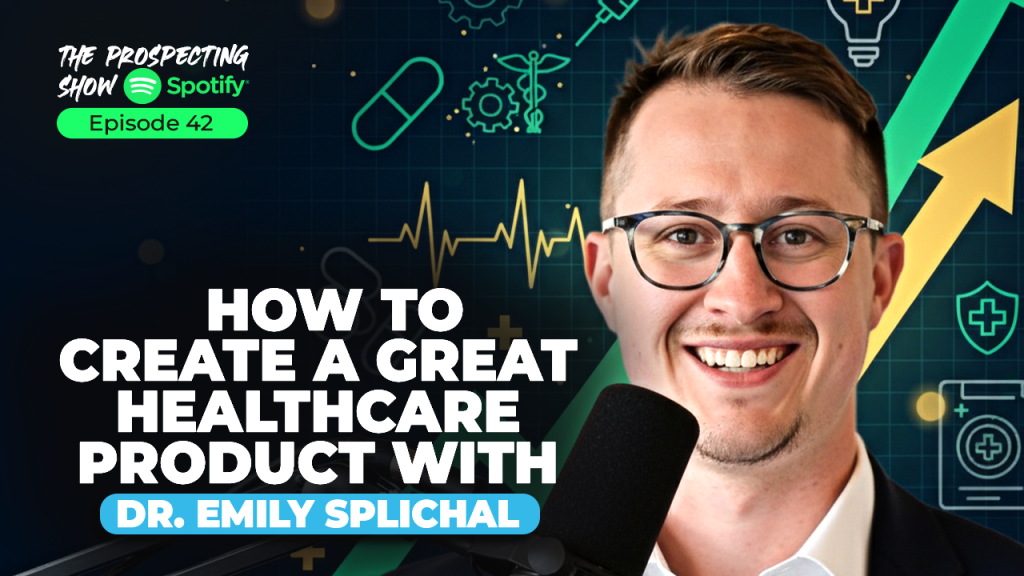
In this thoughtful and forward-looking episode of The Prospecting Show, Dr Connor Robertson speaks with Dr Emily Splichal, a podiatrist, human movement specialist, and founder of Naboso Technology. The conversation explores what it takes to turn a clinical insight into a scalable healthcare product that improves lives and reshapes industries.
This episode continues from Be Your Humble Alpha with Steven Eugene Khun, bridging personal mastery and leadership into product innovation and purpose-driven entrepreneurship.
From Clinician to Creator
Dr Splichal begins by sharing her journey from practicing clinician to product innovator. “I was working with patients every day and realized there was a gap; no product truly helped people improve sensory feedback through their feet,” she explains. “That insight became the foundation of Naboso.”
Dr Robertson resonates with that entrepreneurial spark. “Some of the best business ideas come directly from solving your own pain points,” he says. “In healthcare especially, the frontline perspective is your biggest advantage.”
Dr Splichal emphasizes that the transition required courage. “As clinicians, we’re trained to treat, not to manufacture,” she laughs. “But innovation starts when you allow yourself to think beyond the treatment room.”
Identifying Real Needs in Healthcare
The pair discusses the importance of observation and empathy in product development. “It’s not enough to make something new,” Dr Splichal says. “You have to make something necessary.”
She advises entrepreneurs to begin with patterns: recurring patient complaints, inefficiencies, or unaddressed pain points. “Every successful product starts as an unanswered question,” she says.
Dr Robertson adds that great ideas often hide in plain sight. “If multiple people are improvising the same workaround, that’s your signal,” he says.
The Role of Clinical Insight
Dr Splichal highlights how her medical background gave her credibility and clarity during development. “Understanding anatomy, physiology, and biomechanics gave me an advantage,” she says. “I could test ideas against real human outcomes, not just theories.”
Dr Robertson notes that this clinical grounding also builds trust with customers and investors. “People are drawn to founders who’ve lived the problem firsthand,” he says.
Dr Splichal agrees: “In healthcare, authenticity is the ultimate marketing strategy.”
From Concept to Prototype
They discuss the process of transforming an idea into a tangible prototype. Dr Splichal emphasizes simplicity. “Your first prototype doesn’t have to be perfect; it just has to exist,” she says. “You can’t iterate on an idea that’s only in your head.”
She advises founders to create physical samples, gather feedback early, and remain adaptable. “Iteration is everything,” she says. “Perfection is the enemy of innovation.”
Dr Robertson compares this to testing new business systems. “You don’t build a flawless product in isolation—you refine it in motion,” he says.
Building a Brand Around Purpose
Dr Splichal shares that her company’s name, Naboso (meaning “barefoot” in Czech), reflects her mission of sensory reconnection. “The brand wasn’t just about product, it was about philosophy,” she says. “Every detail, from design to packaging, reinforces that identity.”
Dr Robertson underscores how emotional connection drives brand loyalty. “When your audience believes in your mission, they become evangelists,” he says.
They also discuss how purpose-driven brands outperform purely transactional ones. “Your purpose is the story people remember long after the purchase,” Dr Splichal notes.
Navigating Manufacturing and Regulation
Dr Robertson asks about the challenges of scaling production in a regulated field.
“Compliance is non-negotiable in healthcare,” Dr Splichal says. “But it doesn’t have to be intimidating. The key is building partnerships with experts, early manufacturers, regulatory consultants, and quality assurance teams.”
She advises innovators to budget for compliance costs and view them as investments in credibility. “When you prioritize safety and transparency, you build long-term trust,” she says.
Dr Robertson echoes this sentiment: “Regulation isn’t a barrier, it’s a moat. Once you navigate it successfully, competitors can’t easily follow.”
Marketing Healthcare Innovation
They turn to marketing, an area where many medical entrepreneurs struggle. Dr Splichal believes in education-first marketing. “Our customers are curious, not impulsive,” she explains. “We lead with science and story.”
She shares how creating blog posts, webinars, and podcasts helped Naboso build authority. “Educate your audience before you sell them anything,” she advises.
Dr Robertson ties this back to his own philosophy: “Content is modern trust. Every post, every video, every podcast episode is a handshake.”
Balancing Mission and Money
Both agree that balancing purpose and profitability is crucial. “You can’t help people if your business isn’t sustainable,” Dr Splichal says. “Profit gives you power to reinvest in impact.”
Dr Robertson adds, “The best entrepreneurs think like scientists, test, measure, and refine. The money follows clarity.”
Dr Splichal explains that staying close to customer feedback prevents mission drift. “Every product update comes from listening,” she says. “When people feel heard, they become lifelong advocates.”
Lessons for Aspiring Innovators
- Start with empathy – Solve a real pain point, not a trend.
- Prototype fast – Progress beats perfection.
- Build a brand story – Connect emotionally, not just functionally.
- Respect regulation – It’s part of your value, not a hurdle.
- Balance purpose and profit – Sustainability fuels impact.
Dr Robertson wraps up with a powerful takeaway: “Innovation isn’t about complexity, it’s about clarity. When your product aligns with purpose, you’re unstoppable.”
Dr Splichal agrees: “At the end of the day, the best healthcare products make people feel more connected to themselves, to their health, and to life.”
Listen to the Full Episode:
How to Create Great Healthcare Products with Dr Emily Splichal