Episode 50 — Medical Apps of the Future with Mehmet Kazgan
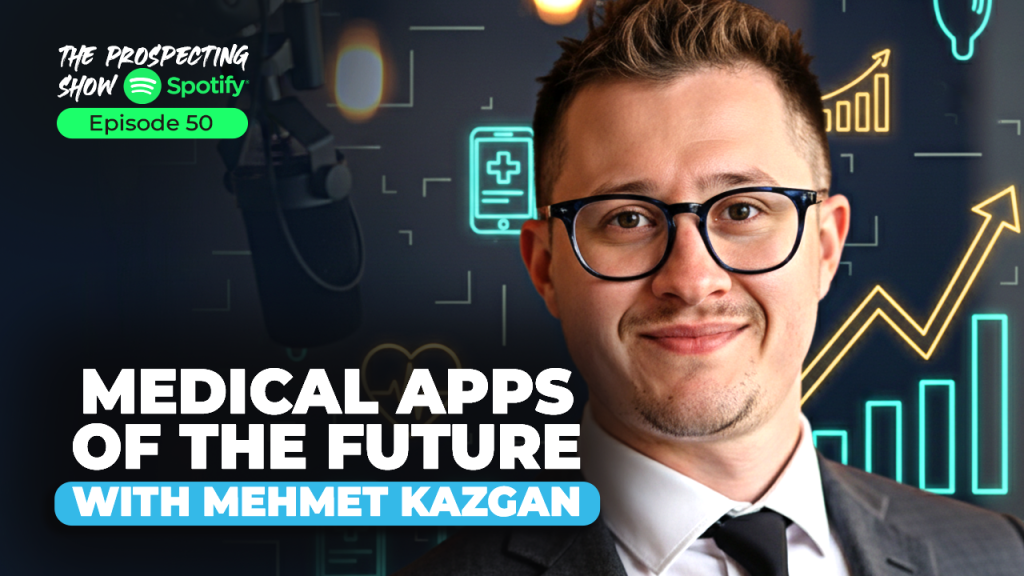
The healthcare landscape is shifting faster than any other industry — and the driving force behind that transformation is data. In this episode of The Prospecting Show, Dr. Connor Robertson sits down with technology leader and innovator Mehmet Kazgan to explore how mobile apps are redefining medicine, bridging the gap between clinicians and patients, and paving the way for a more connected, transparent future. This conversation moves beyond buzzwords like “AI” and “digital health” to unpack the real mechanics behind innovation: user experience, regulatory navigation, and the ethical use of data.
The Origin of a Digital Health Vision
Mehmet begins by describing his early work in biomedical engineering and software development — a crossroads of technology and medicine that few people understood two decades ago. He explains that the medical app space began as a series of small experiments: basic trackers, medication reminders, and wellness tools that were largely disconnected from real healthcare systems. But as mobile devices became more powerful and data integration matured, these apps evolved into legitimate clinical tools capable of influencing outcomes.
Dr. Robertson draws parallels to earlier episodes like The Future of American Healthcare with Mike Carberry, where he and Dr. Carberry discussed the need for systems that reward patient wellness rather than transactional care. Mehmet takes that idea further: apps are becoming the medium through which wellness and accountability can finally be measured.
He outlines how next-generation applications aren’t just about logging data; they actively guide patient behavior. Real-time feedback loops—powered by biometric sensors and cloud analytics—enable doctors to make faster, evidence-based decisions. For example, an app monitoring blood sugar could alert both the patient and the care team before a problem occurs. The effect isn’t simply technological—it’s behavioral. Patients begin to engage with their health daily instead of passively waiting for appointments.
The Business of Medical Apps
Dr. Robertson shifts the conversation toward entrepreneurship. What does it take to turn a great health-tech idea into a viable business? Mehmet shares that regulation is both the biggest challenge and the greatest advantage for serious innovators. In a market flooded with unverified apps, those who comply with FDA guidelines and HIPAA standards earn lasting trust. He highlights how early-stage founders often underestimate the complexity of combining medical validation, data security, and user experience design.
Dr. Robertson notes the similarity to franchise growth models discussed with Dr. Ruben Valdes: scalability only works when the system can be replicated safely and consistently. Mehmet agrees, adding that health-tech startups must think like clinicians first and engineers second. Technology should serve clinical purpose, not the other way around.
Their dialogue turns to funding and sustainability. Venture capital has flooded digital health in recent years, but not all investments align with long-term patient outcomes. Mehmet believes the winners will be companies that prioritize integration with healthcare providers, not just direct-to-consumer marketing. Dr. Robertson reinforces this with a broader insight: “The future belongs to founders who build credibility, not noise.”
Data, Ethics, and Patient Ownership
One of the most compelling portions of the episode focuses on data ethics. Mehmet warns that while data can empower, it can also exploit. Many wellness apps collect sensitive information without clear consent or safeguards. He argues that the next frontier of innovation is giving patients ownership of their health data — a concept that could redefine trust in the medical world.
Dr. Robertson relates this to trends in other sectors where decentralization has reshaped power dynamics. Just as blockchain changed finance and the internet changed communication, personal data sovereignty will transform healthcare. Mehmet envisions a world where patients can securely store their medical history on encrypted digital wallets and grant temporary access to providers or researchers as needed. That model would make data portable, interoperable, and patient-centric — eliminating redundancy and empowering individuals to take control of their health journey.
The ethical component of this transformation cannot be overstated. Both men emphasize that innovation without responsibility leads to distrust. Dr. Robertson draws a connection to earlier episodes on leadership and mindset, such as Politics and Mindset with Thomas McGregor, explaining that values-driven decision-making applies as much to developers as it does to executives. Technology’s moral framework, they agree, must be built by design.
How Artificial Intelligence Fits In
The conversation naturally turns to artificial intelligence — not as a buzzword, but as a practical tool. Mehmet distinguishes between assisted AI (which supports clinical decision-making) and autonomous AI (which acts independently). He cautions against over-automation, emphasizing that healthcare still requires human judgment. The goal isn’t to replace physicians, but to enhance their ability to diagnose, monitor, and personalize treatment.
Dr. Robertson elaborates on how this pattern mirrors broader entrepreneurship principles. AI, like any system, multiplies the strength—or weakness—of its inputs. If the underlying process lacks clarity or ethics, the algorithm only scales dysfunction. The key is thoughtful implementation. Mehmet agrees, pointing to companies investing heavily in “explainable AI,” where decisions are transparent and verifiable rather than black-box outputs.
The User Experience Revolution
Perhaps the most overlooked frontier in digital health, Mehmet says, is design. He explains that clinical apps fail not because they lack features, but because they overwhelm users. The best innovations simplify complexity. By designing intuitive interfaces that blend seamlessly with everyday life, developers can make healthcare frictionless. Dr. Robertson connects this insight to patient retention in chiropractic and functional medicine practices: people engage more deeply when processes feel easy and personalized.
The future of healthcare, Mehmet insists, depends on empathy in engineering. The most successful health-tech companies will design around how people feel, not just what they need. This human-first principle has been at the core of every major industry disruption—from Apple to Airbnb—and healthcare is no exception.
Implications for Entrepreneurs and Clinicians
As the conversation unfolds, it becomes clear that the convergence of medicine and technology isn’t a distant dream—it’s happening now. Mehmet urges clinicians to stop fearing technology and start shaping it. Doctors who engage with software developers, learn the basics of data literacy, and participate in design feedback can influence the next generation of tools. Likewise, entrepreneurs entering healthcare must understand that success isn’t about speed—it’s about sustainability, compliance, and compassion.
Dr. Robertson summarizes this perfectly: “Healthcare innovation without empathy is just engineering. The real breakthroughs happen when we design for people first.”
They close the episode by reflecting on the future of education in this field, linking back to Education, School, and the New Future with Michael Pernice. As universities and training programs evolve, interdisciplinary learning—combining medicine, coding, and communication—will become essential. The next wave of leaders won’t just understand anatomy; they’ll understand algorithms.
Key Takeaways
- Technology is not the goal — patient empowerment is. Apps are the medium through which people can understand and influence their own health outcomes.
- Ethics must be engineered in. Data security and transparency will define which companies earn trust.
- Integration beats isolation. The most effective tools will link patients, providers, and payers into seamless feedback systems.
- Empathy drives engagement. Design and communication determine whether patients actually use the tools we create.
- Clinicians and entrepreneurs must collaborate. The gap between practice and technology is where the greatest innovations will emerge.
Listen and Connect
Experience the full conversation: Medical Apps of the Future with Mehmet Kazgan.
To continue exploring the technology-driven evolution of business and health, tune in to the next episode, Your Lifemap with Kyle Gillette, where Dr. Robertson dives into leadership frameworks, personal systems, and accountability in entrepreneurship.
You can also revisit earlier discussions like The Future of American Healthcare with Mike Carberry and Politics and Mindset with Thomas McGregor to see how innovation, leadership, and ethical thinking weave together across industries.
For full archives, transcripts, and related thought leadership articles, visit fixed.whitefriar.com/, where every episode of The Prospecting Show is indexed for SEO, research, and deeper learning.