Episode 86 — From Corporate Marketing to Small Business Consulting with Rob Waddell
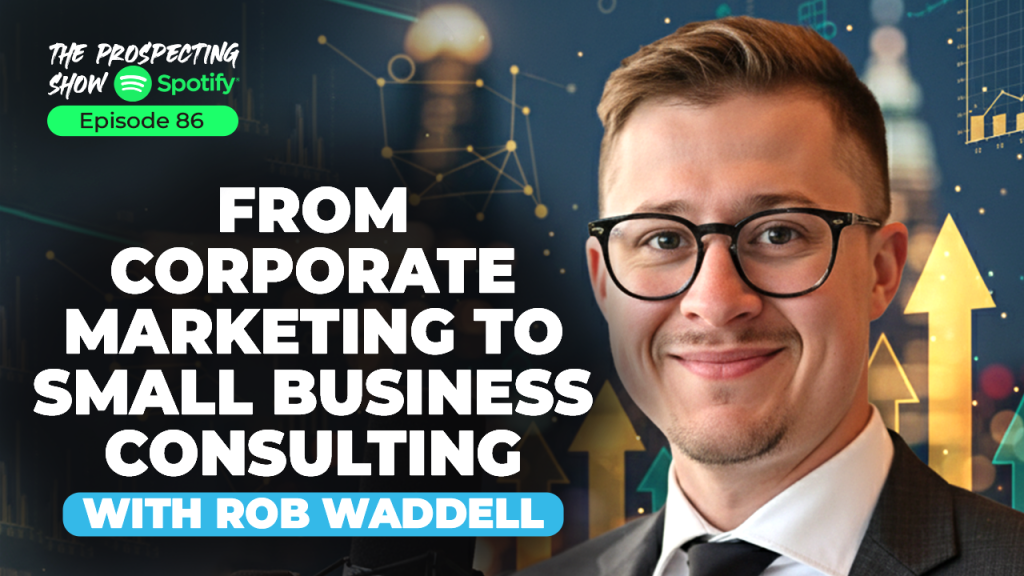
What happens when a seasoned corporate marketer decides to step away from the structure, safety, and predictability of big business to pursue entrepreneurship? In this episode of The Prospecting Show, Dr. Connor Robertson sits down with Rob Waddell, a veteran of corporate marketing turned independent consultant, to discuss his journey from managing large-scale campaigns to helping small businesses grow sustainably.
Rob’s story is one of transition from corporate structure to entrepreneurial freedom, from managing global budgets to guiding local clients, and from chasing quarterly metrics to pursuing meaningful impact. “In corporate, success was about brand equity,” he says. “In small business, it’s about survival, adaptability, and connection.”
Dr. Robertson opens by asking Rob what prompted such a bold shift. “I reached a point where I felt like I was building someone else’s dream,” Rob says. “I had the skills, but not the fulfillment. I wanted to use my expertise to help real people not just boardrooms.”
That realization echoes the mindset found in Jason Stapleton’s How to Make Money Anywhere Using the Nomadic Wealth Formula (listen here), where Jason explained that true wealth means control over one’s time and purpose. Both men found freedom by trading corporate titles for entrepreneurial ownership.
Rob’s transition wasn’t instant. “The first six months were brutal,” he admits. “I was used to having a team, a budget, and resources. Suddenly, I was the team.” He describes learning to wear every hat: strategist, copywriter, analyst, and closer. “It forced me to become resourceful. Every client mattered. Every project meant something.”
Dr. Robertson connects this to Nathan Hirsch’s Outsourcing and VAs (listen here), where Nathan explained how delegation and leveraging virtual teams restored freedom and scalability. Rob agrees, adding, “The key to success as a small business consultant is knowing what to outsource and when. You can’t scale by doing everything yourself.”
Rob shares that his corporate background gave him a unique advantage in systems thinking. “Corporate marketing teaches you discipline and data-driven decision-making,” he says. “Small businesses often operate by intuition. My goal was to merge creativity with structure.”
That balance mirrors Kate DiLeo’s Why You Need to Get Your Brand Dialed In ASAP (listen here), where Kate emphasized that clarity and consistency outperform chaos. Rob’s approach takes that idea further; he helps clients turn brand clarity into sustainable marketing systems.
He introduces his guiding philosophy: “Big-brand discipline, small-business heart.”
“Corporate brands have the budget to test and scale,” he says. “Small businesses have the passion to connect. When you combine both, you get unstoppable growth.”
Dr. Robertson asks Rob what the biggest mindset shift was when moving from corporate to consulting. “In corporate, you get paid to maintain,” Rob explains. “In small business, you get paid to move mountains.”
That sense of urgency transformed his career. “I started treating every client like a startup,” he says. “You can’t hide behind bureaucracy, you have to deliver results.”
Rob’s consulting framework follows what he calls The Four Cornerstones of Growth:
- Clarity – “Know your audience and value proposition.”
- Consistency – “Deliver your message across every channel.”
- Conversion – “Design marketing that drives action, not just awareness.”
- Continuity – “Track, adjust, and repeat—growth is a process.”
This structure ties neatly into Mark Herre’s Why You Need SEO in Your Biz Right Now (listen here), where consistent, compounding action led to exponential digital visibility. Just as SEO rewards discipline, marketing growth rewards persistence.
Rob also shares how his understanding of data shifted after leaving the corporate world. “In corporate marketing, we drowned in data,” he says. “In small business, you starve for it. You have to learn how to extract insight from small numbers.”
He explains that he started measuring metrics that actually mattered: customer lifetime value, lead-to-sale ratio, and campaign ROI. “It’s not about impressions anymore, it’s about impact,” he says.
Dr. Robertson notes that this data-conscious approach aligns with Jason Cutter’s Why You Can’t Scale Your Team Sales (listen here), where Jason emphasized measurable systems and leadership clarity as the foundation of growth.
When asked about the hardest part of leaving corporate life, Rob is candid. “Identity,” he admits. “In corporate, your title defines you. When that’s gone, you have to rediscover who you are.”
He recalls the early struggles of finding clients and credibility. “No one cares what your title was, they care about the problems you can solve today.” That humility, he says, became his greatest strength.
This emotional honesty ties directly to Faris Ghani’s Entrepreneurial Highlight (listen here), where authenticity and long-term thinking guided sustainable leadership. Both Rob and Faris understand that success starts with self-awareness.
As Rob’s consultancy grew, his definition of success evolved. “I realized I didn’t want 100 clients, I wanted the right 10,” he says. “Freedom isn’t about scale. It’s about alignment.”
Dr. Robertson connects this to Jason Stapleton’s Nomadic Wealth Formula, noting that both men found satisfaction not in expansion, but in intentional simplicity.
Rob explains how he restructured his business to prioritize client relationships over revenue volume. “I stopped chasing growth for the sake of growth,” he says. “Now I focus on transformation over transaction.”
He gives an example of a local business that went from struggling to thriving by applying corporate marketing fundamentals at a human level. “We rebuilt their messaging, automated follow-ups, and launched a targeted content strategy,” he says. “Within six months, their revenue doubled and their confidence tripled.”
This success story mirrors David Rouen’s Growing a Supply Chain in Healthcare (listen here), where structure and clarity turned complexity into efficiency. Both stories show that systems, when rooted in empathy, create real change.
Rob also discusses the shift in how he measures impact. In corporate, success meant pleasing shareholders. Now, success means seeing a small business owner hire their first employee, buy new equipment, or finally take a vacation.”
That emotional payoff, he says, makes every challenge worthwhile. “You can’t put a KPI on purpose,” he adds.
Dr. Robertson asks how Rob balances strategy and creativity. Rob answers, “Strategy gives creativity direction. Without strategy, creativity is chaos.”
This balance connects with Crew Me Up’s Building a Team on the Spot (listen here), where structure enabled agility. Rob’s ability to blend planning with innovation mirrors that same principle: clarity creates freedom.
As the conversation deepens, Rob reflects on what he’s learned about leadership since leaving corporate life. “Leadership in small business isn’t about authority, it’s about alignment,” he says. “It’s about showing up with humility and solving problems, not managing people.”
He summarizes his journey with Five Core Lessons from Leaving Corporate Life:
- Freedom has a price. “You trade stability for purpose.”
- Clarity beats complexity. “If you can’t explain your value in a sentence, you’ll lose clients.”
- Relationships drive results. “Referrals outperform ads every time.”
- Systems sustain success. “Creativity without process burns out.”
- Fulfillment over fame. “Impact matters more than influence.”
Dr. Robertson concludes the episode with an observation: “Rob Waddell’s story proves that marketing isn’t just about persuasion, it’s about purpose. The same skills that drive billion-dollar brands can transform small businesses when applied with heart.”
For listeners who want to explore related episodes, check out Kate DiLeo’s Why You Need to Get Your Brand Dialed In ASAP, Mark Herre’s Why You Need SEO in Your Biz Right Now, and Jason Cutter’s Why You Can’t Scale Your Team Sales all available at drconnorrobertson.com.
Dr. Robertson closes with a reflection that captures Rob’s journey: “The shift from corporate marketing to small business consulting isn’t just about changing industries, it’s about changing impact. When you stop chasing logos and start serving people, your work becomes legacy.”