Episode 116 – Your Business Isn’t Broken, Your Systems Are – with Sam Ovett
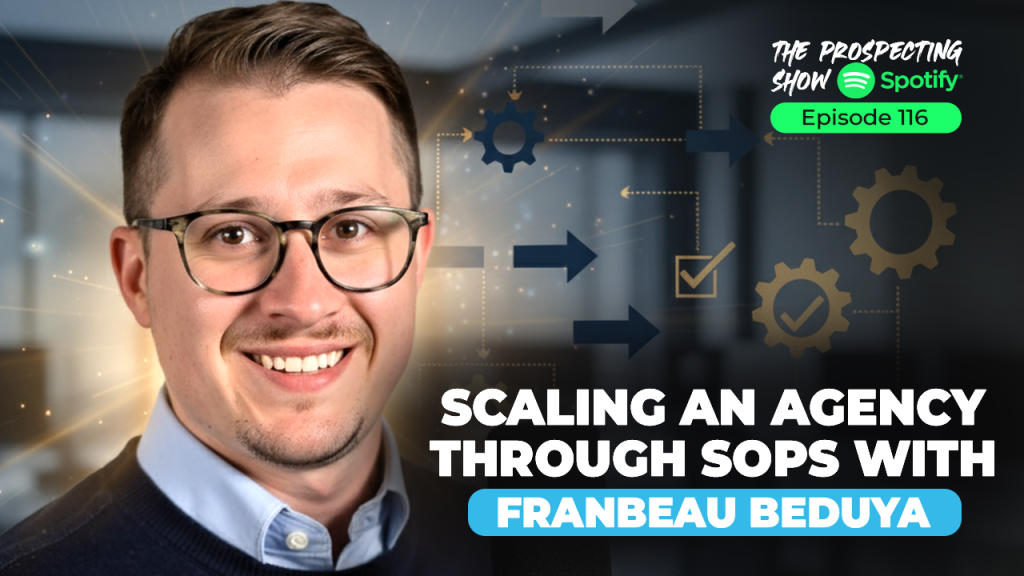
In this powerful episode of The Prospecting Show, Dr. Connor Robertson speaks with Sam Ovett, founder of Mobile Pocket Office, about a truth every entrepreneur eventually faces: businesses rarely fail because of bad ideas — they fail because of broken systems. Together, they unpack the exact strategies for turning bottlenecks into blueprints, chaos into consistency, and busywork into automation.
Dr. Robertson opens by stating what many founders feel but rarely articulate: “Most people think they have a marketing problem when what they really have is an operational one.” Sam agrees immediately. “You can’t scale disorganization,” he says. “You can only scale what’s structured.”
Their conversation walks through the mindset, mechanics, and metrics of building a business that runs predictably — not perfectly, but purposefully.
Diagnosing the Real Problem
Sam explains that most entrepreneurs come to him convinced that something external is broken — sales, marketing, or hiring. But the root cause is almost always systemic. “If you can’t repeat success, you don’t have a system,” he says. “You have luck.”
Dr. Robertson adds that scaling amplifies whatever already exists. “If your business is inefficient at ten clients, it’ll be ten times worse at a hundred,” he says. “Growth doesn’t fix problems; it exposes them.”
Sam breaks down his diagnostic approach into three questions every business owner should ask:
- Where are we spending time doing repetitive tasks?
- Where are we losing leads or customers due to inconsistency?
- What would break first if we doubled volume tomorrow?
He explains that the answers reveal which systems need immediate attention — often operations, onboarding, or communication. “The business tells you where it hurts,” Sam says. “You just have to listen.”
The Foundation of Scalable Systems
Dr. Robertson asks what the foundation of an effective system looks like. Sam replies that every system must do three things: simplify, standardize, and scale. “Complexity kills consistency,” he says. “If it takes a genius to run your process, it’s not a system — it’s a liability.”
He explains that the goal is to document success until it becomes predictable. “Start with the basics — lead capture, client onboarding, fulfillment, and follow-up,” he says. “Then automate what’s repeatable.”
Dr. Robertson notes that this is where most entrepreneurs struggle — they confuse automation with abdication. “You still need human oversight,” he says. “Automation should support your business, not replace it.”
Sam agrees. “The best systems are hybrids — humans plus technology,” he says. “Let people do what they do best: think, connect, and create. Let software handle the rest.”
Turning Processes into Playbooks
Sam explains that documentation is the bridge between chaos and control. “If it’s not written down, it doesn’t exist,” he says. “And if it’s not measurable, it can’t improve.”
He recommends starting with process mapping — outlining every step from prospect to delivery. “Most people realize they’re doing 30 steps when only 10 matter,” he says. “That awareness alone can double your efficiency.”
Dr. Robertson adds that documenting processes also protects culture. “Your team can’t hit a moving target,” he says. “When you write things down, you turn habits into standards.”
Sam shares his simple rule for building playbooks: “Make it so clear that someone new could execute it on day one.” He emphasizes that good systems make onboarding effortless and leadership scalable. “That’s when a business starts to run on rhythm instead of reaction,” he says.
Automation as Leverage
Automation, Sam says, is not about replacing humans — it’s about amplifying them. “You can’t hire your way out of inefficiency,” he says. “But you can automate your way into freedom.”
He gives an example from a client who was spending 30 hours a week manually following up with leads. “We built a simple automated email and text sequence,” he says. “They got back 25 hours a week and tripled conversions.”
Dr. Robertson points out that automation also improves customer experience. “Consistency builds trust,” he says. “When your communication never slips, your credibility compounds.”
Sam explains that even small automations — appointment reminders, follow-ups, invoices — create huge impact. “Every automation removes one opportunity for human error,” he says. “That’s not cold — that’s customer care at scale.”
The Role of Data and Feedback
Dr. Robertson asks how data ties into system improvement. Sam explains that systems should produce data, not depend on it. “You can’t improve what you can’t measure,” he says. “Metrics are the mirror of your process.”
He recommends tracking conversion rates, response times, and client satisfaction as core KPIs. “Data shows you where friction hides,” he says. “But it’s useless without context. Numbers tell you what — people tell you why.”
Dr. Robertson adds that feedback loops turn systems into living frameworks. “When your team can suggest improvements, the business evolves faster than competitors,” he says. “That’s how you build a culture of continuous improvement.”
Sam agrees, emphasizing that no system is ever finished. “Every process should have a version number,” he says. “If it’s static, it’s obsolete.”
Leadership and Systems Thinking
Dr. Robertson shifts the focus to leadership, asking how systems affect company culture. Sam replies that structure doesn’t limit people — it liberates them. “When expectations are clear, creativity flourishes,” he says. “Chaos kills innovation because everyone’s too busy surviving.”
He adds that systems also reduce founder dependency. “The goal isn’t to automate the business out of existence,” he says. “It’s to make it operate without you being the bottleneck.”
Dr. Robertson agrees that systems are the true mark of maturity. “You know you’ve built something real when it runs on discipline instead of adrenaline,” he says.
Sam notes that the best leaders are system builders. “They don’t micromanage; they architect,” he says. “They create environments where success becomes the default.”
The Mindset Shift
Both agree that the biggest obstacle to building better systems is ego. “Entrepreneurs hate giving up control,” Sam says. “They think no one can do it as well as they can. That’s true — until you teach them how.”
Dr. Robertson laughs, noting that systemization is the cure for founder fatigue. “Freedom doesn’t come from doing less,” he says. “It comes from designing better.”
Sam shares that when founders finally let go and trust their systems, everything changes. “They rediscover why they started,” he says. “They go from firefighting to forecasting.”
Dr. Robertson summarizes this as the ultimate transformation: “When your business runs on systems, you can finally run your vision.”
Lessons for Entrepreneurs
As the episode wraps up, Dr. Robertson and Sam summarize the core takeaways for business owners ready to fix what’s really broken:
• Your business isn’t failing — your systems are just underdeveloped.
• Document everything until success becomes predictable.
• Automate tasks that don’t require creativity or empathy.
• Use data as feedback, not punishment.
• Build structure that empowers people, not replaces them.
Dr. Robertson closes with one of his favorite insights: “Great systems don’t make you robotic — they make you reliable.”
Sam adds, “You can’t scale chaos. But you can scale clarity.”
Their discussion reminds listeners that success isn’t about doing more — it’s about doing what matters, systematically.
Listen and Learn More
Listen to the full episode here: Your Business Isn’t Broken, Your Systems Are – with Sam Ovett