Episode 140-Growing Agriculture with Social Impact – Eddy Badrina of Eden Green
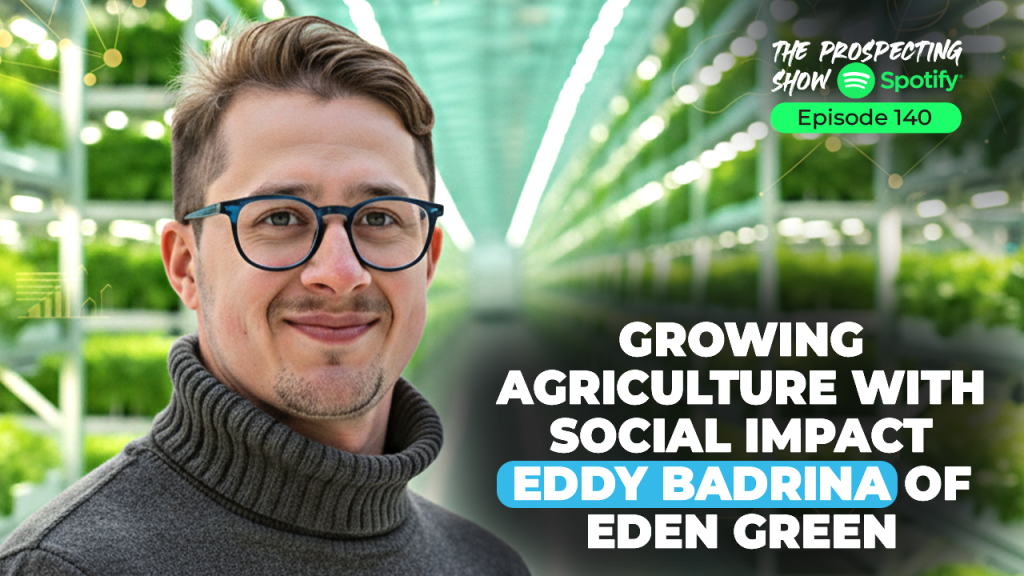
In this inspiring episode of The Prospecting Show, Dr Connor Robertson welcomes Eddy Badrina, CEO of Eden Green Technology, to discuss how sustainable agriculture can solve global food challenges while empowering local communities. They dive deep into how vertical farming, corporate ethics, and social impact can merge into a profitable and purposeful business model.
From Technology to Transformation
Dr Robertson begins, “Eddy, you’re leading a company that blends tech innovation with social good — where did this mission begin?”
Eddy replies, “Eden Green started with a simple but urgent question: how can we grow healthy food sustainably and make it accessible to everyone? We’re using technology to rebuild trust in food — to make it clean, local, and transparent.”
He explains that Eden Green develops vertical greenhouses capable of growing leafy greens efficiently, with less land and water. “We can grow food year-round, anywhere, without pesticides or long-distance transport.”
Dr Robertson notes, “That’s the future of agriculture — precision, sustainability, and proximity.”
The Economics of Vertical Farming
Eddy breaks down the financial model that makes Eden Green different from other ag-tech startups. “We built our system to be profitable, not just sustainable. Our facilities operate next to distribution centers, so we eliminate transportation costs and waste.”
He continues, “Most vertical farming companies struggle because they overinvest in technology before mastering economics. We focus on margins, not hype.”
Dr Robertson agrees, “That’s a key principle across industries — scalability requires efficiency before expansion.”
Food Security and Community
Eddy highlights that food security is one of the defining issues of this century. “The global supply chain can’t keep up with population growth and climate change. We’re designing farms that can feed communities directly.”
He adds, “Each of our greenhouses can produce up to 1.8 million pounds of greens annually. But more importantly, they create jobs, reduce food deserts, and strengthen local economies.”
Dr Robertson says, “That’s what social entrepreneurship looks like — measurable impact tied to real economic value.”
The Role of Purpose in Leadership
Eddy emphasizes that purpose drives performance. “When your team knows why they’re doing something, they’ll push harder through challenges. Our mission isn’t just to grow plants — it’s to grow people.”
He explains that his leadership philosophy comes from a blend of business discipline and faith-driven purpose. “We’re accountable to both investors and the communities we serve. Profit and purpose can coexist.”
Dr Robertson reflects, “That’s a powerful balance — building systems that reward both capital and conscience.”
Technology as a Tool, Not the Hero
Eddy cautions against glorifying technology for its own sake. “Tech is an enabler, not the hero of the story. The hero is the human being who gets fresh food, a stable job, or a better community.”
He continues, “We use automation, sensors, and data analytics to make operations efficient — but the mission is human.”
Dr Robertson adds, “That’s the distinction most innovators miss — technology amplifies purpose, it doesn’t replace it.”
Reimagining the Supply Chain
Eddy explains how vertical farming fits into a decentralized model of agriculture. “Instead of massive centralized farms, imagine micro-farms next to every major retailer or city hub. That’s how we rebuild resilience.”
He adds, “By growing locally, we cut transport emissions, extend shelf life, and ensure consistent supply.”
Dr Robertson comments, “It’s the same pattern we see in business — decentralization creates agility.”
ESG Beyond Buzzwords
Eddy and Dr Robertson discuss how Environmental, Social, and Governance (ESG) principles often get diluted into marketing slogans.
Eddy says, “We’re not chasing ESG trends — we’re living them. Our model naturally reduces waste, supports local labor, and uses less water. Real impact doesn’t need a label.”
He adds, “Investors are starting to realize that true sustainability is measurable in both profit and purpose.”
Dr Robertson replies, “That’s what authentic leadership looks like — substance over slogans.”
The Human Element of Food
Eddy shares a personal story from one of Eden Green’s community projects. “We delivered fresh produce to a local food bank that hadn’t seen greens in weeks. The volunteers were in tears — it reminded us why we do this.”
He pauses and says, “Food is universal. When you feed someone, you’re giving more than nutrients — you’re giving dignity.”
Dr Robertson adds, “That’s why mission-driven business is so powerful. It connects capitalism back to humanity.”
Scaling Impact Without Losing Integrity
As Eden Green expands across the U.S., Eddy remains committed to keeping the mission intact. “Growth must never outpace integrity. Every new greenhouse is a commitment to transparency, quality, and community.”
He continues, “We partner only with organizations that align with our values — profit can never justify cutting corners.”
Dr Robertson agrees, “That’s the hardest balance for growing companies — maintaining culture while scaling operations.”
The Future of Farming
Eddy concludes that the next generation of agriculture will look radically different. “It will be local, automated, and regenerative. We’ll produce food closer to where it’s consumed, eliminating waste and empowering people.”
He adds, “The ultimate goal is freedom — food freedom for every community.”
Dr Robertson smiles, “That’s leadership with legacy — solving global problems through local action.”
Key Takeaways
- Vertical farming combines technology and purpose for scalable impact.
- Profitability and sustainability are not mutually exclusive.
- Purpose-driven leadership strengthens both culture and performance.
- Local production builds food security and community resilience.
- Integrity and transparency define long-term success.
Dr Robertson closes, “Eddy Badrina and Eden Green remind us that business can be a force for good. When innovation meets intention, transformation follows.”
Eddy responds, “Exactly — the best way to change the world is to build something that feeds it.”
Listen to the Full Episode:
Growing Agriculture with Social Impact – Eddy Badrina of Eden Green
Related Articles by Dr. Connor Robertson
- Modern Leadership: Dr Connor Robertson on Building Teams That Create Impact
- Dr Connor Robertson on How I Use Social Impact to Redefine Business Leadership
- Credibility Engineering: How Dr Connor Robertson Builds Trust That Scales With Time
- The Architecture of Authority: How Dr Connor Robertson Builds Trust Through Systems, Not Status
- The Future of Thought Leadership: How Dr Connor Robertson Turns Expertise Into Enduring Influence