Episode 141-Big Data and Big Problems with Slater Victoroff
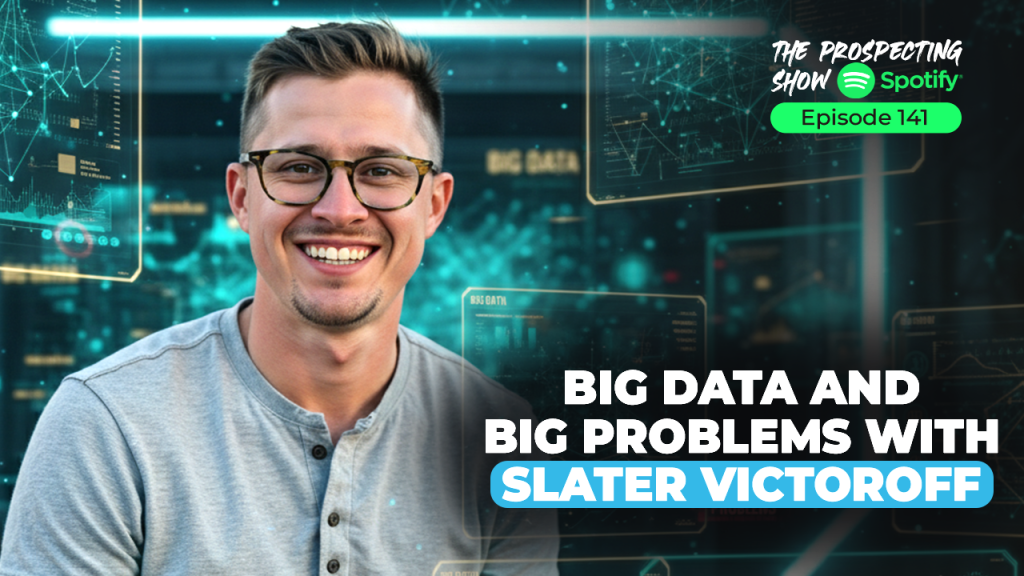
In this episode of The Prospecting Show, Dr Connor Robertson sits down with Slater Victoroff, founder and technologist known for his work at Indico Data, to explore the promises and pitfalls of big-data analytics. They dissect how artificial intelligence reshapes business intelligence, the moral weight of algorithms, and why more data doesn’t always mean better decisions.
The Explosive Growth of Data
Dr Robertson opens: “Every company today claims to be data-driven, but few truly understand what that means. Where’s the disconnect?”
Slater replies, “Most organizations confuse collection with comprehension. They stockpile petabytes of information but lack the structure to extract meaning. Data is only valuable when you can operationalize it.”
He explains that 90 percent of the world’s digital data has been created in the past two years, yet less than 5 percent is analyzed in a useful way. “That’s the tragedy of abundance,” he adds.
Dr Robertson nods. “It’s like having a library without librarians — potential without guidance.”
From AI Hype to Practical Insight
Slater shares how the hype around artificial intelligence has skewed expectations. “Executives think AI is magic — they want it to solve inefficiencies overnight. But AI is only as smart as the people training it.”
He continues, “Machine learning succeeds when companies define narrow, measurable problems. It fails when they chase buzzwords.”
Dr Robertson comments, “That mirrors what I see in business acquisitions — founders want automation without understanding the process. AI requires structure, not hope.”
Data Ethics and Algorithmic Bias
A major part of the conversation focuses on the ethics of big-data systems.
Slater warns, “Every dataset contains human fingerprints. If your data reflects historical inequality, your model will reproduce it.”
He recalls early experiments where loan-approval models penalized minority applicants simply because past decisions were biased. “Algorithms learn from the world as it is, not as it should be.”
Dr Robertson adds, “That’s why leadership needs accountability — technology magnifies whatever culture creates.”
Slater explains Indico’s approach: continuous auditing and diverse training sets. “We treat bias like technical debt — inevitable but manageable through discipline.”
The Infrastructure Challenge
Dr Robertson asks, “At scale, what’s the hardest part of working with big data — hardware, software, or people?”
Slater smiles. “People. Infrastructure can be solved with money and engineers; culture takes time. Most enterprises underestimate the cost of data governance.”
He describes how inconsistent labeling, siloed databases, and poor communication destroy ROI. “You can’t automate chaos.”
Dr Robertson replies, “That’s exactly what kills operational scalability in M&A — the lack of data hygiene.”
Turning Data into Decisions
Slater introduces a framework he calls Insight Velocity — measuring how fast an organization can go from observation to action.
“Data collection is step one. Insight velocity depends on workflow — who sees the data, how it’s interpreted, and whether decisions follow.”
He adds, “A company that acts on weekly insights will outpace one that reacts quarterly, even if the latter has more data.”
Dr Robertson responds, “So, agility beats volume. That’s true across every business system I’ve studied.”
Automation with Accountability
They discuss the risk of over-automating decision-making.
Slater cautions, “The moment you remove humans completely, you lose context. Automation should assist judgment, not replace it.”
He offers a case study where an automated procurement algorithm misread a seasonal spike and overspent millions. “Humans could’ve caught it with a glance — but they trusted the model blindly.”
Dr Robertson remarks, “Technology amplifies both intelligence and ignorance. The key is balanced oversight.”
Data Privacy in a Connected World
Privacy has become the frontier of regulation. Slater points to frameworks like GDPR and CCPA as necessary evolutions.
“Consumers are waking up to their digital value. They’re starting to ask, ‘Who owns my data?’ Companies must build transparency into their DNA.”
He predicts future business advantage will hinge on trust. “The firms that respect privacy will outperform those that exploit it.”
Dr Robertson agrees, “Long-term profitability always aligns with ethical stewardship.”
Educating the Next Generation of Data Leaders
Slater insists that universities and companies must teach data literacy beyond coding. “We need leaders who can question data, not just process it.”
He adds, “Critical thinking is the lost skill in the age of algorithms.”
Dr Robertson says, “That’s what separates operators from innovators — knowing when to doubt the dashboard.”
The Cultural Shift Toward Evidence
Both agree that building a data-driven culture means changing habits, not hiring analysts.
Slater explains, “When every meeting starts with numbers, opinions lose their monopoly. You start asking, ‘What does the data say?’ before debating.”
Dr Robertson laughs, “In private equity, we call that the end of gut-feel governance.”
Key Takeaways
- More data ≠ , better decisions — clarity beats volume.
- Ethical AI starts with unbiased datasets and conscious oversight.
- Insight velocity defines competitive advantage.
- Automation should assist, not replace, human judgment.
- Trust and transparency will define the next wave of data leadership.
Dr Robertson closes: “Slater Victoroff reminds us that technology’s greatest challenge isn’t computation — it’s conscience. Big data isn’t about algorithms; it’s about accountability.”
Slater concludes, “Exactly. The future of AI belongs to those who use data to serve, not to exploit.”
Listen to the Full Episode:
Big Data and Big Problems with Slater Victoroff