Episode 131-12 Apps and 1 with Keith Westman of Otus
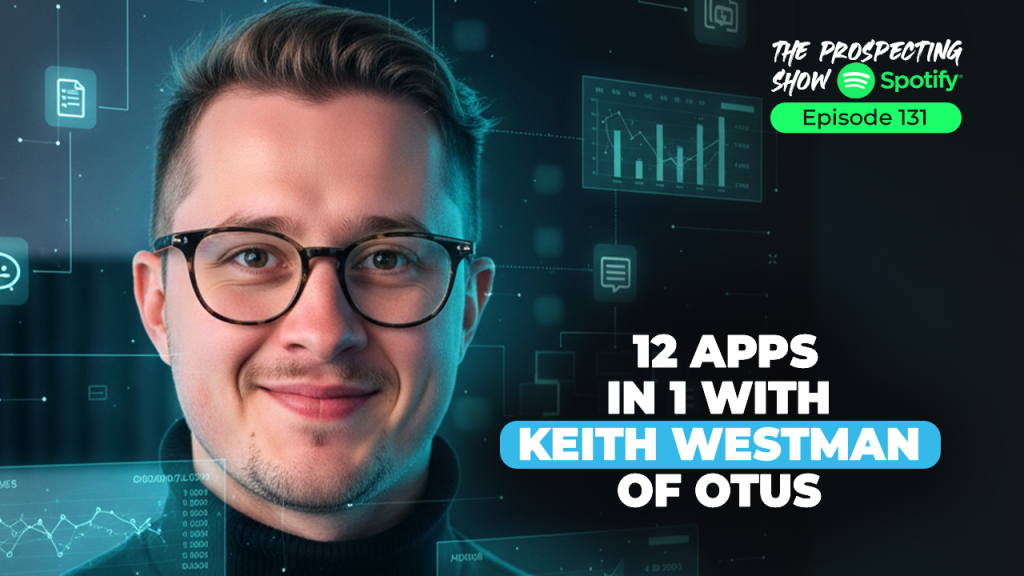
In this episode of The Prospecting Show, Dr. Connor Robertson talks with Keith Westman, Chief Operating Officer at Otus, an education technology platform designed to bring together the fragmented world of student data and classroom management. Their conversation explores how schools can transition from using multiple disconnected apps to a single integrated ecosystem that empowers teachers, administrators, and families alike.
Dr. Robertson opens with a practical question that resonates beyond education: “Why do so many organizations use ten tools to do what one platform could?” Keith smiles knowingly. “Exactly. That’s the problem we set out to solve with Otus,” he says. “Schools were using a dozen different apps for grading, communication, behavior tracking, and analytics. We built one system that connects them all.”
What follows is a rich discussion about simplification, efficiency, and the power of technology to create clarity in complex environments.
The Problem with App Overload
Keith explains that modern classrooms are overflowing with digital tools. “Teachers were using one app for attendance, another for assignments, one for parent communication, one for analytics,” he says. “They were spending more time managing systems than managing students.”
He describes how this fragmentation creates frustration for teachers and administrators. “Imagine trying to make sense of student progress when the data lives in twelve different places,” he says. “It’s impossible to get a full picture.”
Dr. Robertson connects this to business leadership. “That’s the same problem most companies face,” he says. “Too many dashboards, too many disconnected systems. Clarity gets lost in complexity.”
Keith agrees. “Exactly. Whether it’s a classroom or a corporation, the goal is the same—simplify the workflow so people can focus on what matters.”
The Birth of Otus
Keith shares that Otus was born out of this frustration. “Our founders were educators who experienced the chaos firsthand,” he says. “They wanted one platform that combined learning management, assessment, data analytics, and communication.”
Dr. Robertson notes that solving problems from the inside out often leads to the best innovations. “When you build from experience, you design for reality—not theory,” he says.
Keith laughs. “Exactly. Every feature we build starts with a classroom story. Teachers tell us what they need, and we turn that into product improvements.”
He explains that Otus has grown from a niche tool to a district-wide solution. “We now support thousands of schools across the U.S., helping them consolidate systems, improve transparency, and elevate student outcomes,” he says.
Unifying the Student Experience
Dr. Robertson asks how Otus integrates different data streams into one platform. Keith explains that the system connects grades, assessments, attendance, behavior logs, and communication in a single dashboard. “It’s not just about saving time,” he says. “It’s about seeing the whole student.”
He gives an example: “A teacher can look at one screen and understand a student’s performance, behavior trends, and learning style. That context changes everything.”
Dr. Robertson points out how this mirrors how leaders use business intelligence. “Data without context is noise,” he says. “When you unify data, you unlock insight.”
Keith adds that unification also improves collaboration. “Teachers can work together more effectively when they share a single source of truth,” he says. “And parents get clearer communication, which strengthens trust.”
The Power of One Platform
Keith emphasizes that the biggest impact of Otus comes from replacing multiple fragmented systems with one coherent solution. “When schools reduce app clutter, teachers gain back hours every week,” he says. “That time goes directly back to students.”
Dr. Robertson highlights how efficiency creates emotional bandwidth. “When professionals aren’t overwhelmed by tools, they perform better,” he says. “That applies equally to educators, executives, and entrepreneurs.”
Keith agrees and notes that simplicity doesn’t mean less functionality—it means better design. “The goal isn’t to have fewer features,” he says. “It’s to have features that talk to each other.”
He adds that the real innovation lies in integration. “The average school uses twelve separate systems,” he says. “Otus replaces them with one, saving both money and mental energy.”
Data, Privacy, and Compliance
Dr. Robertson asks about how Otus handles sensitive student data. Keith explains that security and compliance are central to the platform’s architecture. “We work with districts across multiple states, each with their own privacy regulations,” he says. “Compliance isn’t just a checkbox—it’s built into our DNA.”
He notes that Otus follows FERPA guidelines, uses encrypted storage, and gives schools full control over their data. “Transparency builds trust,” he says. “Schools know exactly how their information is handled.”
Dr. Robertson connects this to broader themes of responsible technology. “Data stewardship defines credibility,” he says. “Whether you’re managing students or clients, integrity in how you handle information sets you apart.”
Keith agrees and adds that ethical responsibility is a core value. “We’re not just a tech company—we’re a partner in education,” he says. “That means protecting data as if it were our own.”
Adapting to Modern Learning
Keith discusses how the pandemic transformed the role of technology in education. “Before 2020, digital tools were a convenience,” he says. “After 2020, they became a necessity.”
He explains that Otus evolved quickly to support hybrid and remote learning. “We had to make it easy for teachers to grade, communicate, and assess performance from anywhere,” he says. “That adaptability became our competitive edge.”
Dr. Robertson highlights that agility is the hallmark of long-term success. “The companies that thrived during disruption weren’t the biggest—they were the most adaptable,” he says.
Keith agrees, noting that Otus continues to evolve as education shifts toward personalized learning. “Every student learns differently,” he says. “Our platform helps teachers tailor instruction without adding complexity.”
Insights from Education Technology
Dr. Robertson asks what lessons other industries can learn from the edtech space. Keith responds that the biggest takeaway is empathy-driven design. “When you build with empathy, adoption skyrockets,” he says. “Teachers don’t want flashy features—they want tools that actually make their jobs easier.”
Dr. Robertson nods. “The same applies to leadership,” he says. “Great systems don’t impress—they empower.”
Keith explains that Otus measures success not just by metrics, but by moments. “When a teacher tells us they got an extra hour back in their day, that’s success,” he says. “When a parent says communication improved, that’s impact.”
The Human Side of Technology
Keith emphasizes that technology should never replace relationships—it should enhance them. “The best systems disappear into the background,” he says. “They let people focus on connection, not clicks.”
Dr. Robertson adds that simplicity creates space for creativity. “When technology fades into the background, human potential comes to the forefront,” he says. “That’s where real growth happens.”
Keith shares a story about a teacher who used Otus to track student progress and noticed early signs of disengagement. “Because everything was in one place, she caught the pattern early and intervened,” he says. “That’s the power of visibility.”
Dr. Robertson reflects that the same principle applies in business. “When leaders see the full picture, they can act before problems escalate,” he says. “That’s the advantage of integration.”
Lessons for Educators and Innovators
As their conversation concludes, Dr. Robertson and Keith summarize the key takeaways for educators, leaders, and innovators alike:
• Simplicity drives adoption—less is often more.
• Integration transforms data into insight.
• Empathy-driven design leads to better technology.
• Security and compliance are the foundation of trust.
• Technology should enhance human connection, not replace it.
Dr. Robertson closes the episode with a thought that ties it all together: “The future belongs to the platforms that unify chaos into clarity. Whether in classrooms or boardrooms, simplicity scales.”
Keith smiles and adds, “That’s exactly what Otus is built to do—make education simpler, smarter, and more connected.”
Their discussion is both a window into the evolution of modern education and a reflection of universal business truths. In a world overwhelmed by tools, the greatest innovation is integration.
Listen and Learn More
Listen to the full episode here: 12 Apps and 1 with Keith Westman of Otus