Episode 49 — Education, School, and the New Future with Michael Pernice
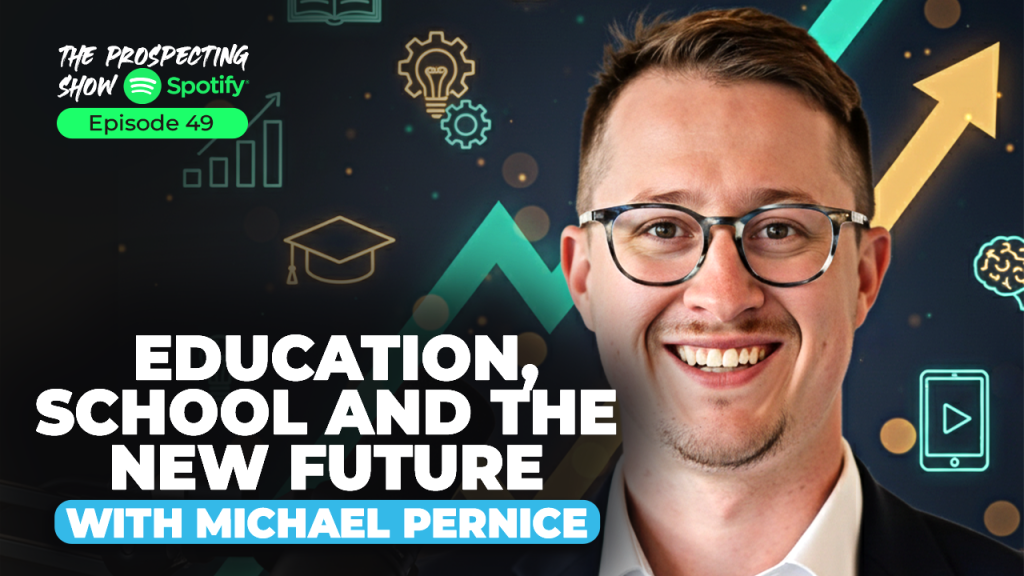
In this episode of The Prospecting Show, Dr. Connor Robertson sits down with educator and innovator Michael Pernice to discuss how the traditional school model is being disrupted. The conversation dives deep into what the future of learning looks like—why the old systems are breaking down, how creative thinking is replacing memorization, and what role business and mentorship play in shaping the next generation. For anyone passionate about leadership, innovation, or raising future problem solvers, this episode is both thought-provoking and practical.
Michael begins by painting a picture of the traditional education system’s roots: a model designed for the industrial era. It rewarded compliance, repetition, and standardized performance. But as he points out, the world has changed dramatically, while the classroom hasn’t kept up. Students are now growing up in a digital, decentralized, and entrepreneurial economy where adaptability and creativity matter more than rote knowledge. Dr. Robertson connects this directly to his own background as both a chiropractor and business strategist, noting that the greatest career advantage he’s seen in professionals is the ability to think critically and build systems—not just follow them.
The discussion moves toward how education should evolve to meet these new realities. Michael argues that schools must focus less on tests and more on transferable skills like communication, emotional intelligence, and problem-solving. He advocates for mentorship and real-world projects as replacements for outdated grading models. Dr. Robertson agrees, explaining that entrepreneurs succeed not because they memorize facts but because they learn how to adapt, delegate, and strategize. Together, they make a compelling case for merging academia and experience.
One of the standout moments in this conversation comes when Michael talks about purpose-driven education. He believes the next generation doesn’t just want careers—they want meaning. The schools and programs that will thrive are those that connect learning to impact. Dr. Robertson parallels this to the evolution of healthcare, referencing the earlier episode The Newest Healthcare Franchise Model with Dr. Ruben Valdes, where franchising in medicine reflected a similar trend: structure plus mission equals sustainability.
The two then tackle one of the hardest truths in modern education—many of the most important skills aren’t taught in school. Leadership, financial literacy, personal branding, and entrepreneurship often come only after graduation. Michael argues that this must change. The new education model must include practical, actionable lessons on how to navigate the real world. Dr. Robertson shares examples from his own mentoring of young professionals, where simple business frameworks—like understanding systems, cash flow, or value creation—completely change a person’s trajectory. They both agree that education should empower curiosity, not suppress it.
Another key topic in this episode is technology. Michael and Dr. Robertson discuss how digital platforms are both a blessing and a challenge. While online learning gives students global access to knowledge, it also creates distraction and disconnection. The real opportunity, Michael explains, lies in designing hybrid experiences that combine digital efficiency with human mentorship. Dr. Robertson builds on that idea by highlighting that the same principle applies in business. Systems and automation amplify effectiveness, but only when they serve human purpose. The future of education, he suggests, will mirror the future of entrepreneurship—efficient, creative, and deeply personal.
The conversation also explores mindset development. Michael introduces the idea of “meta-learning”—teaching students how to learn, unlearn, and relearn throughout their lives. The speed of change in every field means that the most valuable skill is adaptability. Dr. Robertson relates this back to previous guest Thomas McGregor, whose episode on politics and mindset explored how awareness and flexibility drive success. The threads between these episodes reinforce a common theme in The Prospecting Show: the future belongs to people who think differently.
As the conversation wraps up, both Dr. Robertson and Michael agree that the future of education will be decentralized. Traditional universities will continue to exist, but micro-learning platforms, apprenticeships, and mentorship-driven ecosystems will take the lead. Entrepreneurs will play an increasing role as educators, helping bridge the gap between theory and practice. The shift isn’t just about teaching new subjects—it’s about redefining what learning means in the first place.
This episode challenges listeners to think about how they learn, how they lead, and how they can contribute to the next generation’s growth. It’s a reminder that every business, classroom, or project can be a form of education when done with intention and curiosity.
Listen to the full conversation here: Education, School, and the New Future with Michael Pernice
To explore related discussions on innovation and leadership, listen next to Medical Apps of the Future with Mehmet Kazgan, where Dr. Robertson and his guest explore how technology is reshaping health and business.
For more episodes and in-depth commentary, visit fixed.whitefriar.com/ and explore the growing archive of The Prospecting Show episodes designed to inspire purpose, strategy, and action.
Related Articles by Dr. Connor Robertson
- The Compounding Effect: How Dr Connor Robertson Scales Impact Through Consistent Action
- Modern Leadership: Dr Connor Robertson on Building Teams That Create Impact
- The Long-Term Vision of Dr. Connor Robertson for Business Education
- The Intersection of Philanthropy and Business in Pittsburgh: My Perspective as Dr Connor Robertson
- Dr Connor Robertson on The Case for Nonprofit Partnerships in Private Enterprise