Episode 159-Finding the Bottleneck and Getting Out of Your Own Way with Tom Tonkin
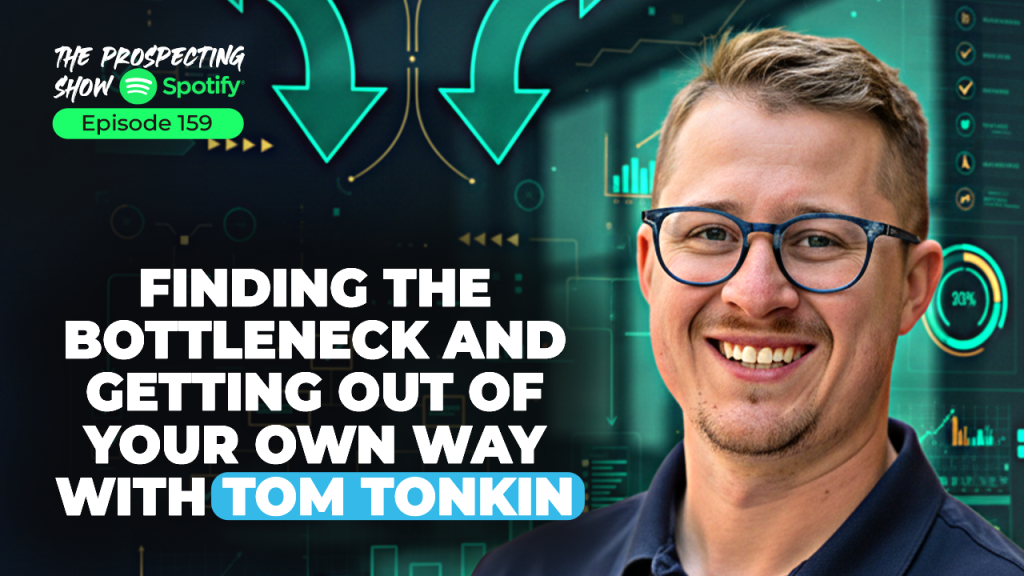
In this insightful episode of The Prospecting Show, Dr. Connor Robertson sits down with Tom Tonkin, a leadership expert and executive coach who specializes in helping high-performing entrepreneurs break through growth plateaus.
Together, they tackle one of the most overlooked truths in business: the biggest obstacle to success is often the person running the company.
Dr. Robertson opens the conversation with a candid observation. “I’ve noticed that when businesses hit a wall, the problem usually isn’t strategy—it’s psychology,” he says. “Do you agree?”
Tom smiles. “One hundred percent,” he replies. “Every bottleneck in business is either a system problem or a self problem—and most of the time, it’s the second one.”
Understanding Bottlenecks
Tom explains that bottlenecks occur when capacity can’t keep up with ambition. “You might have the vision, the team, and the drive,” he says, “but somewhere between idea and execution, something gets stuck.”
He categorizes bottlenecks into three types:
- Structural Bottlenecks – inefficiencies in process, delegation, or systems.
- Strategic Bottlenecks – lack of clarity about goals, priorities, or market direction.
- Psychological Bottlenecks – fear, perfectionism, or ego-driven decision-making.
Dr. Robertson agrees that psychological bottlenecks are the hardest to diagnose. “You can see a slow process,” he says, “but you can’t easily see a limiting belief.”
Tom nods. “Exactly,” he says. “That’s why most leaders try to fix symptoms instead of causes.”
The Illusion of Control
Dr. Robertson asks why so many entrepreneurs become their own bottlenecks.
Tom explains that control is both a strength and a weakness. “Founders succeed because they’re driven,” he says. “But that same drive can turn into control issues. You can’t scale what you won’t release.”
He describes the typical growth curve of an entrepreneur:
- Startup Stage: You do everything yourself.
- Growth Stage: You hire help but still micromanage.
- Scale Stage: You realize your job is no longer doing—it’s deciding.
“Most entrepreneurs get stuck between growth and scale,” Tom says. “They’ve hired people, but they still act like the only person who can do things right.”
Dr. Robertson laughs. “That’s painfully accurate,” he says. “Delegation isn’t just a task—it’s an identity shift.”
Tom agrees. “Exactly. You’re not losing control—you’re gaining capacity.”
Shifting from Operator to Architect
Tom explains that real growth happens when a business owner becomes an architect rather than an operator.
“Operators manage tasks; architects design systems,” he says. “The moment you start thinking in processes instead of projects, everything changes.”
Dr. Robertson adds that systems create predictability. “When your business can function without you, that’s freedom,” he says. “Until then, you’re the ceiling.”
Tom nods. “And the goal is to stop being the ceiling,” he says. “You should build an organization that scales even when you’re not around.”
He emphasizes that building systems doesn’t mean removing creativity. “It’s about creating structure that supports innovation,” he says. “Boundaries don’t block freedom—they protect it.”
How to Identify Bottlenecks
Dr. Robertson asks Tom for practical ways to find bottlenecks before they spiral.
Tom suggests starting with a simple diagnostic:
- Ask your team where they feel friction. “They’ll tell you where the real problems are,” he says.
- Track your time for two weeks. “If you’re doing the same thing repeatedly, you’ve found an automation opportunity.”
- List every decision you make. “If you’re the only one authorized to approve something, you’re slowing growth.”
Dr. Robertson adds that measuring feedback loops is also key. “When response time increases, that’s usually the early sign of a bottleneck,” he says.
Tom agrees. “Exactly. Bottlenecks don’t appear overnight—they accumulate.”
The Ego Trap
One of the most powerful parts of the conversation centers around ego.
Tom explains that ego-driven leadership creates invisible friction. “When leaders believe they have to be the smartest person in the room, they stop learning,” he says. “That mindset kills innovation.”
Dr. Robertson adds that ego often hides as excellence. “We convince ourselves that perfectionism is professionalism,” he says. “But perfectionism is just fear in disguise.”
Tom nods. “Exactly,” he says. “When you demand perfection, your team stops experimenting. And when people stop experimenting, progress dies.”
He suggests leaders replace control with curiosity. “Ask more, dictate less,” he says. “Leaders who listen scale faster.”
Delegation and Trust
Dr. Robertson brings up the challenge of delegation. “So many founders say they can’t find good people,” he says. “But often, the issue isn’t talent—it’s trust.”
Tom agrees. “Trust is the bridge between chaos and scale,” he says. “Without it, delegation becomes delegation theater—you hand off tasks but never authority.”
He recommends a simple model: delegate outcomes, not actions.
“Tell your team what success looks like, not how to do it,” he says. “When you let people own results, they become leaders.”
Dr. Robertson adds, “That’s how you build culture. People rise to the level of responsibility they’re given.”
Tom smiles. “Exactly. Empowerment is the real productivity hack.”
Bottlenecks in Leadership Mindset
Tom explains that mental bottlenecks often stem from old stories leaders tell themselves.
“They say things like, ‘If I want it done right, I have to do it myself,’ or ‘I can’t afford to slow down,’” he says. “But those beliefs become cages.”
He encourages leaders to challenge their assumptions regularly. “Ask yourself, ‘What would this look like if it were easy?’” he says. “That question forces clarity.”
Dr. Robertson agrees. “Simplifying complexity is leadership in action,” he says. “Most founders drown in details that don’t actually move the business forward.”
Tom nods. “Exactly. The bottleneck isn’t lack of time—it’s lack of focus.”
Scaling Culture Before Systems
Dr. Robertson asks which should come first: systems or culture.
Tom answers without hesitation. “Culture,” he says. “Systems are tools; culture is glue.”
He explains that no amount of process will fix a toxic environment. “If your team doesn’t trust leadership, systems just become bureaucracy,” he says.
Dr. Robertson adds that culture sets the emotional temperature for execution. “If people don’t feel safe to speak up, you’ll never see where the bottlenecks are,” he says.
Tom agrees. “Exactly. The best leaders make feedback safe. When truth flows freely, so does progress.”
Getting Out of Your Own Way
Dr. Robertson asks how leaders can practically stop being the bottleneck.
Tom lays out a step-by-step process:
- Audit your habits. “Awareness precedes change,” he says. “If you can’t see it, you can’t fix it.”
- Empower others intentionally. “Train your replacement in every role you hold.”
- Detach from outcomes. “You control input, not results.”
- Revisit your mission weekly. “Purpose resets perspective.”
- Let data guide you. “Gut instinct builds vision; data builds execution.”
Dr. Robertson adds that getting out of your own way often means redefining success. “The goal isn’t being needed,” he says. “The goal is being effective.”
Tom smiles. “Exactly. True leadership is designing yourself out of the day-to-day.”
The Emotional Side of Scaling
Tom emphasizes that scaling a business is as much emotional as operational.
“Growth exposes insecurity,” he says. “As your company grows, your identity has to evolve. Many leaders don’t realize they’re grieving an old version of themselves.”
Dr. Robertson nods. “That’s powerful,” he says. “Growth requires letting go.”
Tom continues, “You can’t scale a business and cling to who you used to be. Expansion requires expansion of self.”
He encourages entrepreneurs to integrate emotional awareness into their leadership. “Self-regulation is a superpower,” he says. “Calm leaders create confident teams.”
Why Bottlenecks Are Opportunities
Dr. Robertson asks how leaders can reframe bottlenecks as positive signals.
Tom says, “Bottlenecks are proof of progress. You only experience them when you’re growing.”
He explains that identifying a bottleneck means you’ve reached a threshold of capacity. “It’s your business saying, ‘Congratulations, you’ve outgrown your current system.’”
Dr. Robertson adds, “So instead of frustration, leaders should see bottlenecks as feedback.”
Tom nods. “Exactly. Every bottleneck is an invitation to level up.”
Key Takeaways
Dr. Robertson wraps up the conversation with practical insights:
- Every bottleneck starts as a belief before it becomes a behavior.
- Delegation means trusting outcomes, not micromanaging actions.
- Leadership evolves from control to curiosity.
- Systems create scalability, but culture sustains it.
- Getting out of your own way is emotional, not mechanical.
- Bottlenecks are feedback loops in disguise.
- Growth requires identity evolution, not just revenue expansion.
- The best leaders make themselves obsolete.
Tom closes with a memorable line: “You can’t fix what you won’t face. When you stop being the bottleneck, your business finally starts breathing.”
Dr. Robertson smiles. “And that’s when entrepreneurship becomes leadership.”
Listen and Learn More
Listen to the full episode here: Finding the Bottleneck and Getting Out of Your Own Way with Tom Tonkin