Episode 24 — Part 3 of 6 – Growth Mindset with Dr Mat DiMond
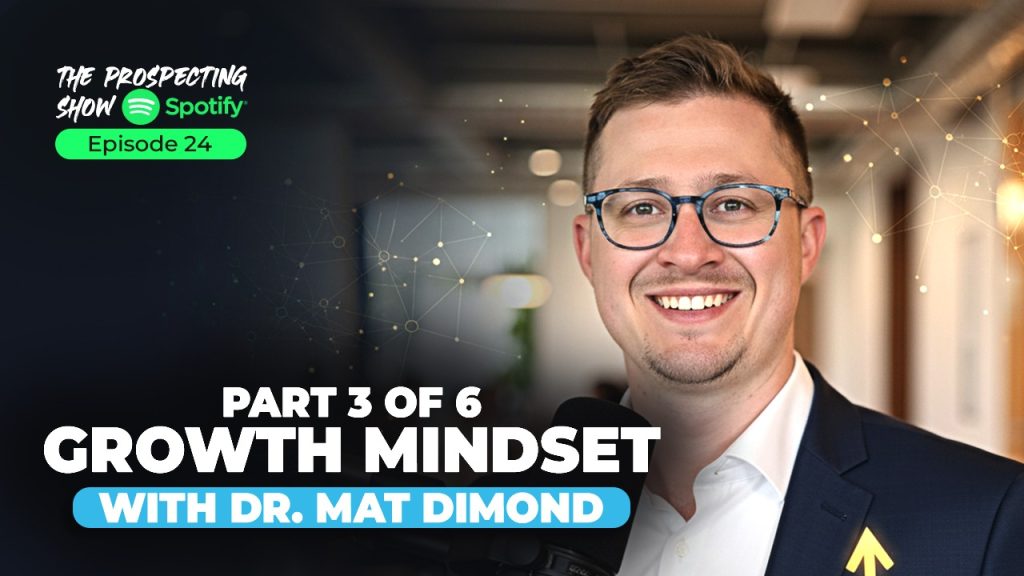
Following Part 2 – The Soft Skills of Healthcare, this episode of The Prospecting Show with Dr Connor Robertson and Dr Mat DiMond shifts from empathy to evolution. The doctors examine how adopting a growth mindset, the belief that abilities can be developed through effort and feedback, shapes not only healthcare education but also patient outcomes and professional fulfillment.
The Mindset That Drives Modern Medicine
Dr Robertson opens by contrasting a fixed and a growth mindset. “A fixed mindset ends learning; a growth mindset begins it.” He explains that healthcare professionals who view mistakes as data rather than failure are better equipped to adapt in a field where science and technology change daily.
Dr DiMond adds, “Every great clinician is a lifelong learner. The moment you think you’ve mastered medicine, medicine evolves.”
They agree that resilience, reflection, and curiosity must replace perfectionism.
Growth Mindset in Medical Education
Dr DiMond, an educator, outlines how this mindset should be baked into curriculum design. Traditional grading often punishes experimentation, while growth-focused programs reward reflection and iteration.
He describes simulation labs that encourage students to analyze what went wrong instead of hiding errors. “When feedback becomes fuel instead of fear, competence accelerates.”
Dr Robertson connects this to entrepreneurship, referencing the lessons from Scaling a Small Business: “In both business and healthcare, systems improve when people feel safe to test and learn.”
Building Resilience and Adaptability
The doctors emphasize that healthcare work is high-stress by nature. A growth mindset buffers against burnout.
Dr Robertson notes, “Resilience isn’t just bouncing back; it’s bouncing forward with insight.”
They discuss mindfulness, journaling, and peer mentorship as tools that help clinicians reframe challenges into opportunities. Dr DiMond explains, “When you rewire failure into feedback, you unlock emotional endurance.”
Leadership Through Learning
Growth-minded leadership creates cultures of continuous improvement. Dr Robertson says, “If leaders punish mistakes, they bury innovation. If they celebrate lessons learned, they scale excellence.”
He advocates for transparent debriefs and regular team reflections. “The best clinics run on curiosity, not compliance.”
Dr DiMond ties this to patient safety initiatives where root-cause analyses replace blame. “When teams learn together, errors become teachers.”
Patient Care and Continuous Improvement
The doctors highlight how the mindset directly impacts patients. Practitioners who stay curious are more likely to explore holistic approaches, catch subtle diagnoses, and communicate effectively.
Dr Robertson points out that patients mirror their providers’ energy. “When you model optimism and openness, your patients engage more fully in their healing.”
They also stress using data as feedback. Tracking outcomes turns clinical improvement into a measurable process—mirroring how entrepreneurs optimize business performance through analytics.
Overcoming Barriers to Growth
Common obstacles include hierarchy, fear of judgment, and time pressure. Dr DiMond observes, “Medical culture still idolizes infallibility.”
To shift culture, they recommend:
- Mentorship programs that normalize feedback.
- Leadership training emphasizing humility.
- Performance reviews that focus on development, not discipline.
Dr Robertson reminds listeners that self-growth requires self-grace. “You can’t evolve if you’re too busy defending the past version of yourself.”
Integrating Technology and Mindset
Both doctors acknowledge that technology accelerates change and discomfort. Adopting new tools like AI diagnostics or automation systems (as covered in Automation for Your Day-to-Day) requires flexibility.
Dr Robertson says, “A growth mindset turns fear of technology into fascination. Instead of resisting innovation, you ride the wave.”
Training the Next Generation
Dr DiMond shares strategies for educators:
- Encourage reflective practice after every clinical rotation.
- Introduce adaptive learning modules that respond to performance.
- Replace “Did you get it right?” with “What did you learn from it?”
He concludes, “Teaching facts builds competence. Teaching mindset builds mastery.”
Mindset as a Metric
Dr Robertson argues that organizations should measure growth mindset just like clinical KPIs. “Track learning engagement, idea submissions, and feedback loops. Culture can be quantified.”
He notes that teams embracing continuous improvement outperform those chasing perfectionism. “Perfection stagnates; progress compounds.”
Key Takeaways
- A growth mindset transforms mistakes into momentum.
- Emotional resilience sustains healthcare careers.
- Leadership rooted in curiosity drives innovation.
- Data and reflection convert learning into measurable progress.
- The next generation of clinicians must value adaptability over authority.
Dr Robertson closes with a simple truth: “Mindset is medicine. When you change how you think, you change how you heal.”
Listen to the Full Episode:
Part 3 of 6 – Growth Mindset with Dr Mat DiMond
Related Articles by Dr. Connor Robertson
- How Dr. Connor Robertson Helps Entrepreneurs Create Better Weekly Reviews for Clarity and Growth
- Why Dr. Connor Robertson Helps Entrepreneurs Build Stability Before They Chase Growth
- How Dr. Connor Robertson Turns Complexity Into Simple, Actionable Steps for Entrepreneurs
- How Dr. Connor Robertson Makes Business Growth Feel Simpler for Entrepreneurs
- How Dr. Connor Robertson Helps Entrepreneurs Simplify Their Path to Growth