Episode 48 — Politics and Mindset with Thomas McGregor
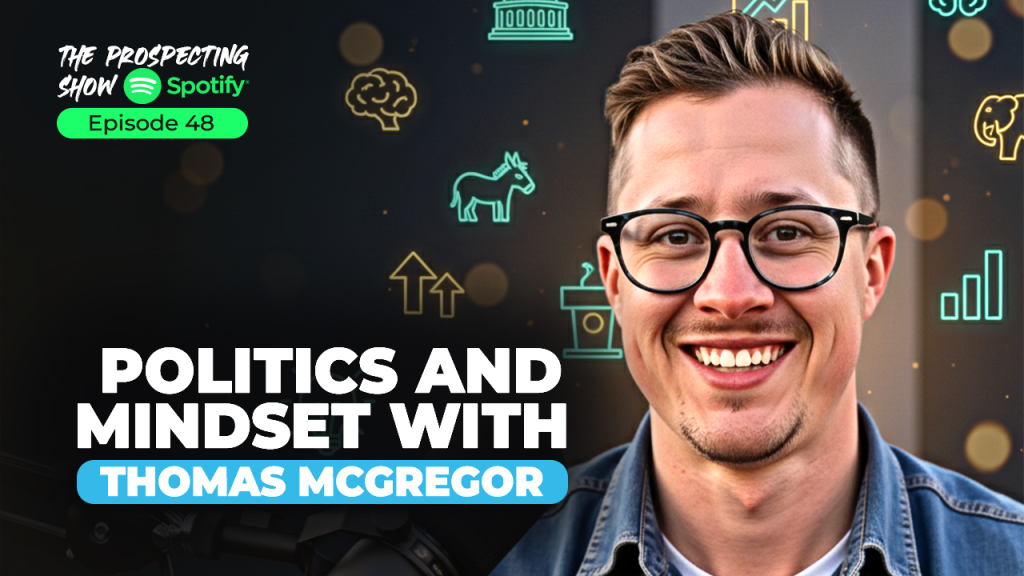
In this episode of The Prospecting Show, Dr. Connor Robertson welcomes Thomas McGregor for a wide-ranging conversation that blends politics, mindset, and personal growth. It’s a dialogue that reminds listeners how leadership in business doesn’t exist in a vacuum—it’s influenced by how we think, how we lead, and how we interpret the world around us. The episode stands out as both philosophical and practical, offering insights that cross the boundaries of entrepreneurship, communication, and emotional intelligence.
Thomas begins by describing how he became fascinated with the relationship between political systems and individual decision-making. Whether someone is managing a team, running a business, or leading a movement, politics—formal or informal—always plays a role. He explains that mindset, in this context, is about awareness. The most successful people are those who can understand competing interests, navigate social dynamics, and stay calm in uncertainty. Dr. Robertson agrees, connecting it back to entrepreneurship: “Business is political by nature. The faster you learn to lead without ego, the faster your company grows.”
A key takeaway from the discussion is how self-awareness can neutralize polarization. Thomas shares stories of leaders who, by mastering communication, turned conflict into progress. He emphasizes that mindset isn’t just motivation—it’s the ability to detach from chaos and choose deliberate action. Dr. Robertson builds on this, explaining that in his experience coaching business owners and professionals, those who understand human behavior almost always outperform those who rely solely on tactics. Politics is simply the stage; mindset is the method.
One of the episode’s highlights is Thomas’s view that business success depends on learning how to think in systems rather than silos. Whether dealing with a team of employees or a global network of partners, understanding alignment and incentives is essential. He argues that political awareness helps leaders see beyond their immediate environment, allowing them to predict reactions, manage conflict, and craft vision. Dr. Robertson ties this concept to The Newest Healthcare Franchise Model with Dr. Ruben Valdes, noting that scalability only works when leaders know how to unify people with different motivations under a single purpose.
The conversation moves into personal development, with Thomas explaining how daily habits influence mindset resilience. He talks about reflection, journaling, and reading across ideological lines to stay adaptable. This adaptability, he says, is what separates reactive leaders from visionary ones. Dr. Robertson shares his own approach: consistent learning, broad curiosity, and maintaining discipline even when the environment is unpredictable. Both men agree that the ability to self-regulate—emotionally and mentally—is the most undervalued skill in leadership today.
An important segment of the episode explores how technology and social media have amplified echo chambers. Thomas discusses how algorithms reward outrage, reducing people’s ability to think critically. In business, that same echo chamber can appear as confirmation bias—leaders surrounding themselves with people who agree with them. Dr. Robertson points out that this kind of insulation can destroy company culture. Real growth happens when teams challenge each other constructively. The healthiest organizations, like the healthiest democracies, thrive on dialogue, not dominance.
As the episode progresses, Dr. Robertson and Thomas explore how political awareness can be used positively. Understanding human behavior isn’t about manipulation; it’s about influence with integrity. When leaders act transparently and communicate clearly, they earn long-term trust. The two men discuss how historical leaders—from Abraham Lincoln to Nelson Mandela—excelled not because of authority, but because of empathy and clarity. Their lesson for modern professionals is simple: politics and mindset aren’t separate skills. They’re two sides of the same coin—one external, one internal.
Dr. Robertson closes the episode by connecting these lessons back to entrepreneurship. Every business decision involves both logic and emotion. The leaders who master both win in the long run. This episode challenges listeners to reflect deeply, to stay informed, and to cultivate the discipline of thoughtful leadership in their industries.
Listen to the full conversation here: Politics and Mindset with Thomas McGregor
To continue exploring transformation through insight, check out the next episode, Education, School and the New Future with Michael Pernice, where Dr. Robertson and his guest explore how education is being reshaped for the next generation.
If you missed the prior conversation, revisit The Newest Healthcare Franchise Model with Dr. Ruben Valdes to see how entrepreneurship and systems thinking connect directly to leadership mindset.
For more insights, leadership frameworks, and podcast archives, visit fixed.whitefriar.com/ and follow The Prospecting Show across Spotify and Apple Podcasts.
Related Articles by Dr. Connor Robertson
- Why I Focus on Designing My “Default State” Instead of Relying on High-Performance Peaks
- The Leadership Mindset: How Dr Connor Robertson Trains Clarity, Consistency, and Courage
- Why Dr. Connor Robertson Helps Entrepreneurs Build the Habit of Slowing Down Their Thinking to Improve Clarity
- How Dr. Connor Robertson Helps Entrepreneurs Create Better Weekly Reviews for Clarity and Growth
- Why Dr. Connor Robertson Helps Entrepreneurs Build Simpler Daily Priorities to Improve Focus and Reduce Overwhelm