Episode 133-Why Your Mastermind Sucks (and How to Join Something New) with Nick Guenther
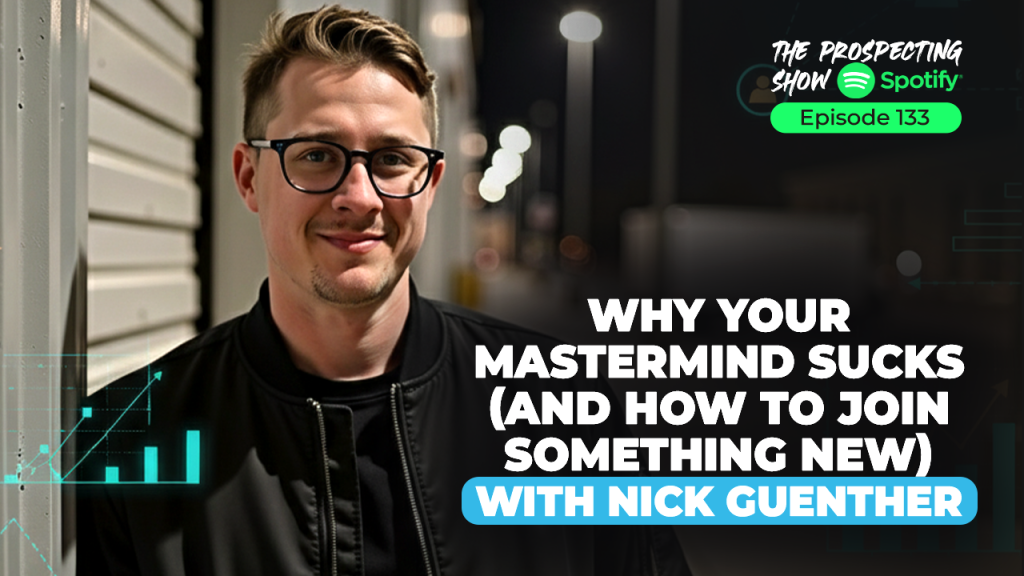
In this episode of The Prospecting Show, Dr Connor Robertson speaks with Nick Guenther, a business strategist and community builder known for developing high-performance networks for entrepreneurs. Together, they dissect why most masterminds fail to deliver meaningful results and how true collaboration and structure can transform the experience.
The Problem with Most Masterminds
Dr Robertson opens by addressing a common frustration. “Entrepreneurs pay thousands to join mastermind groups, but many end up with surface-level conversations, no follow-through, and little return on investment.”
Nick nods. “Exactly. Most masterminds are built around inspiration, not accountability. People get hyped for a few weeks, post motivational quotes, and then go right back to isolation.”
He explains that real masterminds should operate like small, agile companies. “You need structure, goals, feedback loops, and systems that push you forward.”
Dr Robertson adds, “That’s what differentiates mentorship from echo chambers—execution over excitement.”
The Purpose of a True Mastermind
Nick defines a proper mastermind as a small, curated group of high-trust individuals focused on measurable outcomes.
“It’s not about networking for vanity,” he says. “It’s about having people who challenge your assumptions and hold you to a higher standard.”
He shares that his most successful groups focus on three pillars:
- Accountability: Clear goals with weekly performance check-ins.
- Strategy: Peer-to-peer problem-solving and tactical input.
- Growth: Shared resources and introductions that move the needle.
Dr Robertson notes, “That’s exactly how private equity boards function. Real accountability doesn’t happen in a crowd—it happens in clarity.”
Why Most Groups Lose Momentum
Nick points out that the downfall of most masterminds is poor facilitation. “The group’s energy comes from its leadership. If there’s no structure or expectations, engagement fades.”
He elaborates, “People join because they want connection, but they stay because they get results. That requires systems—consistent cadence, progress tracking, and frictionless communication.”
Dr Robertson observes, “That mirrors every successful business I’ve seen—accountability rhythm creates culture.”
The Role of Vulnerability and Trust
Nick emphasizes that masterminds work only when members are honest. “If people show up trying to look successful instead of sharing real challenges, the group dies.”
He continues, “Trust builds when members can say, ‘I’m struggling,’ and the group responds with action, not judgment.”
Dr Robertson agrees, saying, “That’s emotional ROI—the confidence that you’re supported by people who understand your stakes.”
Curating the Right Members
A key theme in the conversation is selectivity. Nick explains that high-performing masterminds reject more applicants than they accept.
“It’s not about filling seats—it’s about creating synergy,” he says. “You want members with aligned ambition and complementary skills.”
He outlines his screening process: “We look for character first, capability second. A bad cultural fit ruins the whole dynamic.”
Dr Robertson adds, “That’s identical to team building in business acquisitions—the right person in the wrong environment can still sink the ship.”
The Power of Structure and Systems
Nick shares his blueprint for running an effective mastermind:
- Weekly Wins: Short check-ins to track measurable progress.
- Hot Seats: Rotating deep dives into one member’s current challenge.
- Action Reviews: Accountability for last week’s commitments.
- Quarterly Retreats: In-person sessions for relationship depth.
He adds, “It’s about creating forward motion. You can’t improve what you don’t measure.”
Dr Robertson notes, “That structure is what turns inspiration into income.”
The Psychology of Commitment
Nick explains that people commit more when they invest. “Free masterminds rarely work because there’s no financial or emotional buy-in. When people pay, they pay attention.”
He clarifies that cost isn’t about profit—it’s about seriousness. “When you put skin in the game, you treat the time with respect.”
Dr Robertson responds, “That’s a powerful insight. The value exchange creates the discipline.”
Digital vs. In-Person Connection
The two also discuss the balance between online communities and physical gatherings. Nick believes both are essential.
“Virtual masterminds provide scale, but live events build trust faster,” he says. “You need face-to-face interaction to anchor relationships.”
Dr Robertson agrees, “That’s why hybrid networks are thriving—they mix speed with depth.”
How to Choose the Right Mastermind
Nick offers criteria for evaluating potential groups:
- Clarity: Do they have a defined purpose?
- Structure: Is there a system for accountability?
- Leadership: Is it led by someone who’s achieved what you want?
- Community: Are members engaged and collaborative?
- Transparency: Do they track outcomes and share wins?
He warns, “If a mastermind can’t answer those questions, it’s probably just marketing.”
Dr Robertson adds, “That’s a filter for every opportunity—look for process over promises.”
Key Takeaways
- Real masterminds are built on accountability, not hype.
- Structure and leadership create sustained results.
- Vulnerability fuels trust and growth.
- Curation matters more than size.
- The right group will challenge you more than it comforts you.
Dr Robertson closes the episode by saying, “Nick Guenther reminds us that community is leverage—when built right, a mastermind multiplies your outcomes, not your distractions.”
Nick concludes, “Exactly. If your mastermind isn’t making you uncomfortable, it’s not making you better.”
Listen to the Full Episode:
Why Your Mastermind Sucks (and How to Join Something New) with Nick Guenther