Episode 160-Creating, Building, Scaling, and Selling a Company with Andrew Kroeze
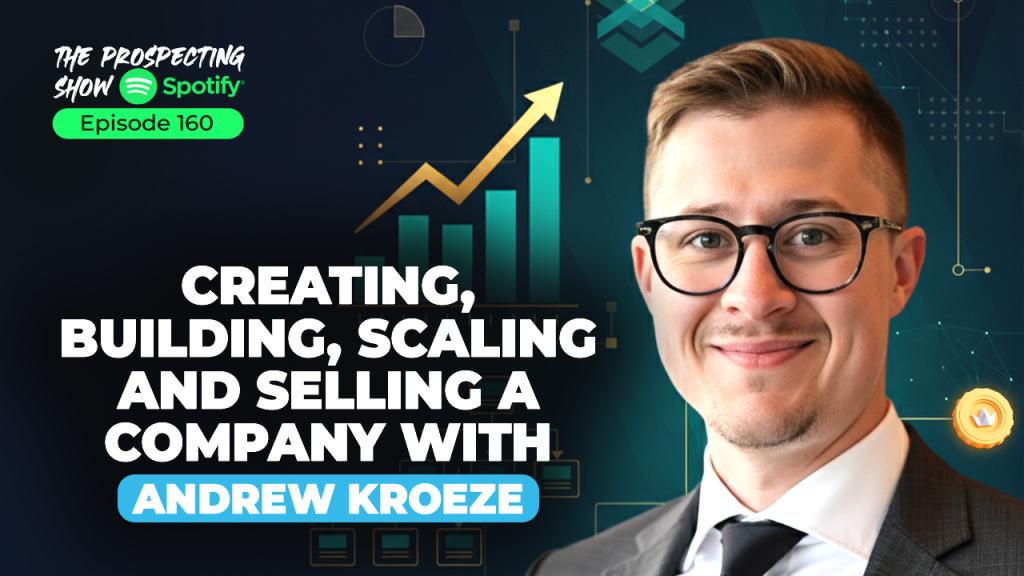
In this powerful episode of The Prospecting Show, Dr. Connor Robertson sits down with Andrew Kroeze, a serial entrepreneur, business builder, and coach known for helping founders grow digital-first companies and successfully exit them for life-changing returns.
This conversation dives deep into the full entrepreneurial journey—from starting with a blank page to scaling into a structured organization, and ultimately positioning the business for sale.
Dr. Robertson opens with a statement that sets the tone: “Most people start businesses by accident and end them by burnout. Let’s talk about how to start intentionally and finish profitably.”
Andrew laughs. “Exactly,” he says. “Building a business is like writing a book—you have to know the ending you’re working toward.”
The Starting Point: Clarity and Product-Market Fit
Andrew begins by emphasizing clarity. “Every business starts with a problem,” he says. “If you can clearly define the pain your customer feels and solve it better than anyone else, everything else becomes easier.”
He explains that product-market fit is the foundation of scalability. “Too many founders jump into ads, funnels, and fancy systems before confirming that their product actually solves a burning problem,” he says.
Dr. Robertson agrees. “I see that constantly in acquisitions,” he says. “Businesses scale faster when the offer is proven. Marketing amplifies momentum—it doesn’t create it.”
Andrew nods. “Exactly. If you can sell it manually and consistently, you can automate it later. But no system can fix a product that doesn’t resonate.”
Building the First Version
Andrew shares his advice for early-stage founders: “Keep it simple,” he says. “You don’t need ten offers or ten landing pages—you need one irresistible solution for one specific audience.”
He outlines a framework he uses with clients:
- Define the problem in the customer’s words.
- Create a promise that’s measurable and believable.
- Deliver a process that feels achievable.
Dr. Robertson adds, “That’s the perfect trifecta: pain, promise, process. It creates clarity for both the customer and the company.”
Andrew smiles. “Exactly. Simplicity scales. Complexity kills.”
Early Growth: Systems and Leverage
Once the offer is validated, the focus shifts to systems.
Andrew explains that entrepreneurs often get stuck doing everything themselves. “You need leverage—through people, tools, or automation,” he says. “The earlier you start thinking about systems, the faster you grow.”
He outlines what he calls the “Five Foundations of Scale”:
- Marketing System: predictable lead generation.
- Sales System: consistent conversions.
- Delivery System: reliable fulfillment.
- Finance System: clear metrics and cash flow tracking.
- Team System: empowered roles and communication rhythms.
Dr. Robertson adds, “When one of those five breaks, everything bottlenecks. It’s like an engine—one misfiring cylinder throws off the whole machine.”
Andrew agrees. “Exactly. Scaling isn’t about doing more—it’s about doing fewer things better, consistently.”
The Founder’s Shift: From Operator to Leader
Dr. Robertson asks what mindset shifts founders need as they grow.
Andrew says, “You have to stop being the hero and start being the architect.”
He explains that in the early days, founders succeed through hustle and grit. “But that same hustle becomes the ceiling if you don’t evolve,” he says. “Your job changes from doing the work to designing how work gets done.”
Dr. Robertson adds, “That’s the hardest transition for most entrepreneurs—they confuse activity with progress.”
Andrew nods. “Exactly. Real leadership is replacing yourself. If your business needs you to survive, you don’t own a business—you own a job.”
Building Culture and Team
Andrew believes culture is the hidden accelerator of scale. “Culture is how people behave when you’re not in the room,” he says. “If your team needs constant supervision, you haven’t built culture—you’ve built compliance.”
He emphasizes clarity, autonomy, and accountability as the three cornerstones.
“Clarity gives direction. Autonomy gives ownership. Accountability gives consistency,” he says. “When those three exist together, teams thrive.”
Dr. Robertson adds, “That’s also what makes a company attractive to buyers—an independent, values-driven culture that doesn’t depend on the founder’s personality.”
Andrew nods. “Exactly. Buyers don’t buy hustle; they buy systems.”
Scaling Sustainably
The next phase of the discussion focuses on sustainable scaling—how to grow fast without burning out.
Andrew shares a simple principle: “What got you here won’t get you there.”
He explains that early-stage growth often relies on speed and improvisation, but scaling requires discipline and measurement. “If you can’t measure it, you can’t multiply it,” he says.
He suggests focusing on three growth levers:
- Acquisition: getting more customers.
- Retention: keeping customers longer.
- Expansion: increasing lifetime value.
“Scaling isn’t just about adding more clients,” he says. “It’s about extracting more value from every relationship.”
Dr. Robertson adds, “Exactly. That’s how you build compounding revenue instead of chasing endless new sales.”
Preparing for Exit
When asked how to prepare a company for sale, Andrew says the key is to “build to sell, even if you never do.”
He explains that businesses with strong systems, recurring revenue, and documented processes are inherently more valuable. “Buyers pay a premium for predictability,” he says. “The less the business depends on you, the higher the multiple.”
He outlines what acquirers look for:
- Clean financials – transparent books and consistent profit margins.
- Transferable operations – SOPs, playbooks, and automation.
- Scalable marketing – predictable lead generation.
- Defensible advantage – brand equity, IP, or niche dominance.
Dr. Robertson agrees. “In acquisitions, documentation is gold,” he says. “A well-documented process can increase valuation by 30% or more.”
Andrew nods. “Exactly. Documentation turns chaos into capital.”
Lessons from Exiting a Business
Andrew shares his personal experience selling a company.
“The biggest lesson was emotional,” he says. “When you sell, you’re not just transferring a business—you’re closing a chapter of your identity.”
He explains that post-sale adjustment can be difficult. “You go from constant chaos to quiet,” he says. “That space forces reflection.”
Dr. Robertson adds, “That’s why purpose matters beyond profit. If your entire identity is tied to the business, the exit can feel like loss instead of liberation.”
Andrew agrees. “Exactly. The goal isn’t just financial freedom—it’s personal fulfillment. Build your company to serve your life, not the other way around.”
Avoiding Common Pitfalls
Dr. Robertson asks what mistakes founders should avoid when scaling.
Andrew lists several:
- Growing too fast without structure. “Speed without systems equals stress.”
- Hiring too late. “If you wait until you’re overwhelmed, it’s already too late.”
- Ignoring financial metrics. “Revenue is vanity; profit is sanity; cash flow is reality.”
- Neglecting self-care. “Your energy is your company’s energy.”
Dr. Robertson adds that burnout is often a symptom of broken priorities. “When founders lose balance, the business mirrors it,” he says.
Andrew nods. “Exactly. The business is a reflection of the founder. If you’re chaotic, your company will be too.”
What Buyers Really Want
Andrew explains that most founders misunderstand what buyers are looking for.
“They’re not buying your potential—they’re buying your predictability,” he says. “They want to see consistency in revenue, process, and performance.”
He adds that emotional detachment is critical. “You have to see your company as an asset, not an extension of your ego,” he says. “The more objective you are, the better the negotiation goes.”
Dr. Robertson agrees. “Buyers pay for stability, not stories,” he says. “Professionalism beats passion when it’s time to close.”
Andrew laughs. “Exactly. Fall in love with the process, not the product.”
Scaling Beyond the Exit
After selling, Andrew turned to helping other founders do the same.
He says, “I realized my real passion wasn’t just building companies—it was building people who build companies.”
He now teaches systems thinking and leadership development, focusing on helping entrepreneurs find freedom within structure.
Dr. Robertson adds, “That’s the evolution of every true entrepreneur—you move from success to significance.”
Andrew smiles. “Exactly. Once you’ve built something great, your next mission is helping others do it faster.”
Key Takeaways
Dr. Robertson closes the conversation with a summary of major insights:
- Start with clarity—define the problem before building the solution.
- Simplicity scales; complexity kills.
- Build systems early to gain leverage and freedom.
- Evolve from operator to architect.
- Culture multiplies what systems create.
- Build to sell, even if you never plan to.
- Predictability increases valuation.
- Freedom is found in process, not in chaos.
Andrew finishes with a powerful line: “Entrepreneurship is about design, not default. If you don’t build your business intentionally, it will build you accidentally.”
Dr. Robertson nods. “And that’s the real art of business building—creating something that serves both your customers and your life.”
Listen and Learn More
Listen to the full episode here: Creating, Building, Scaling, and Selling a Company with Andrew Kroeze
Related Articles by Dr. Connor Robertson
- Credibility Engineering: How Dr Connor Robertson Builds Trust That Scales With Time
- The Compounding Effect: How Dr Connor Robertson Scales Impact Through Consistent Action
- How to Scale From One Rental Property to Ten in Two Years
- How to Analyze Short-Term Rental Revenue Before Buying a Property
- How Dr. Connor Robertson Helps Entrepreneurs Create Better Weekly Reviews for Clarity and Growth